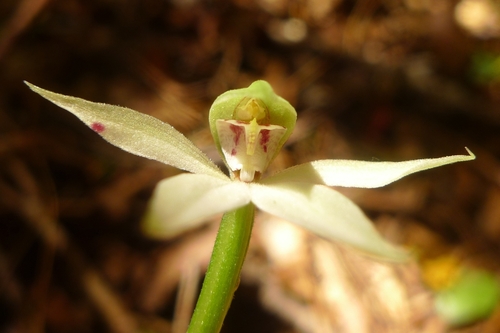
About Pterostylis mutica R.Br.
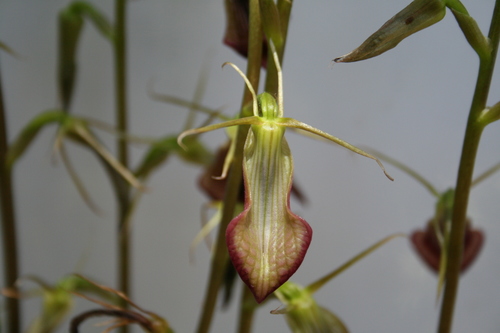
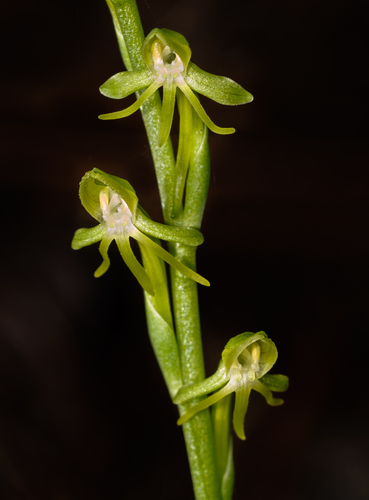
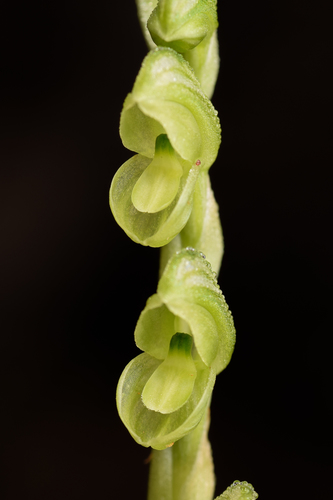
Pterostylis mutica R.Br. is a terrestrial, perennial, deciduous herb that grows from an underground tuber. It produces a basal rosette of six to twelve egg-shaped leaves; each leaf measures 10–30 mm (0.4–1 in) long and 5–15 mm (0.2–0.6 in) wide. Two to twenty well-spaced flowers grow on a flowering stem 150–350 mm (6–10 in) tall, with five to ten stem leaves wrapped around the spike. The flowers are pale green, 8–10 mm (0.3–0.4 in) long and about 5 mm (0.2 in) wide. The dorsal sepal and petals join to form a hood called a "galea" that covers the column; the galea is curved with a pointed tip that points downwards. The lateral sepals turn downwards, measure about 7 mm (0.3 in) long and 8 mm (0.3 in) wide, are cupped, and are joined for most of their length. The labellum is about 4 mm (0.2 in) long, about 2 mm (0.08 in) wide, whitish-green, and bears a dark green appendage. Flowering occurs from July to December.
Pterostylis mutica is widespread and often common, growing in a wide range of habitats from near the coast to inland mountains, and usually grows in well-drained soil. It tolerates dry conditions, poor soil, and exposed positions. It is widespread across New South Wales and Victoria, and also occurs in south-east Queensland, south-eastern South Australia, and the south-west of Western Australia. There is uncertainty about whether the species occurs in Tasmania.
The labellum of Pterostylis mutica attracts a species of gnat. When a gnat lands on the labellum and grasps the dark green appendage, the labellum springs upward, trapping the insect inside the now-closed flower. The gnat can only escape by pushing through the "wings" on the sides of the column. As it escapes, the gnat either removes a pollinium from the current flower or deposits a pollinium it picked up from a previous visit to another flower of the same species, resulting in pollination.