About Pterostylis hamata Blackmore & Clemesha
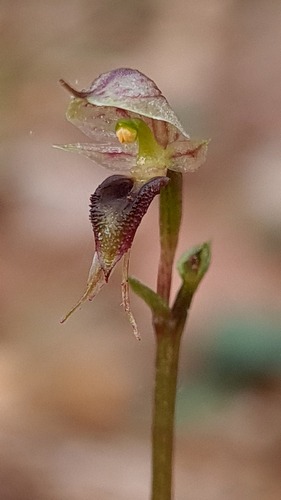
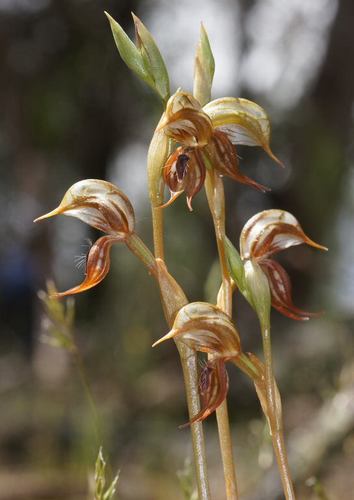
Pterostylis hamata is a terrestrial, perennial, deciduous herb that grows from an underground tuber. It produces a rosette of six to fifteen egg-shaped leaves at the base of the flowering spike; each leaf measures 20–30 mm (0.8–1 in) long and 6–12 mm (0.2–0.5 in) wide. Between two and twelve transparent flowers marked with green and brown grow on a 200–400 mm (8–20 in) tall flowering spike. Each flower is 19–22 mm (0.7–0.9 in) long and 7–8 mm (0.3–0.3 in) wide. Two to eight stem leaves wrap around the flowering stalk. The dorsal sepal and petals form a hood called a "galea" over the column, with the dorsal sepal ending in a downturned, thread-like point 4–7 mm (0.2–0.3 in) long. The lateral sepals point downwards, are joined for roughly half their length, and are shallowly dished with inwardly curved edges. The lateral sepals narrow abruptly to thread-like tips 12–15 mm (0.5–0.6 in) long, which curve forwards and end in hooked points. The labellum is brown, fleshy, and insect-like, about 5 mm (0.2 in) long and 2 mm (0.08 in) wide, with a groove along its length and long and short bristles along its edges. Flowering takes place from September to November. This species, commonly known as the southern hooked rustyhood, grows in rocky sites within open forest. It occurs in the eastern half of New South Wales, the northeastern corner of Victoria, and Queensland.