About Pterostylis falcata R.S.Rogers
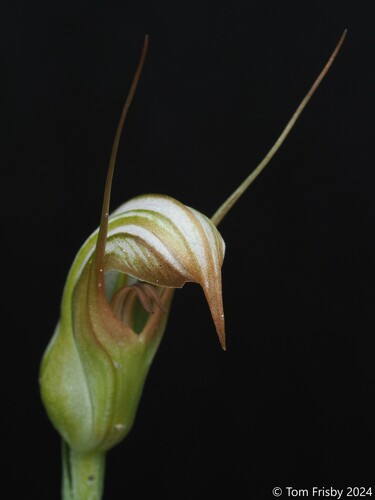
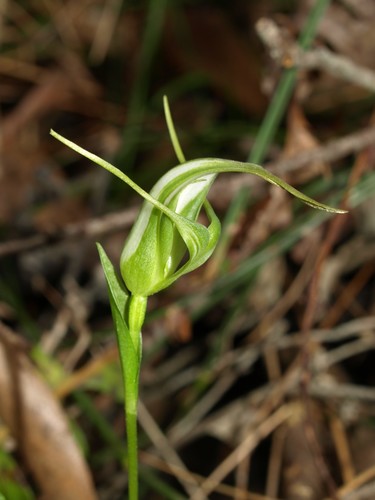
Pterostylis falcata R.S.Rogers is a terrestrial, perennial, deciduous herb that grows from an underground tuber. It produces a rosette of three to six bright green leaves around the base of its flowering stem. Each leaf is lance-shaped to egg-shaped, between 30 and 80 mm (1 to 3 inches) long and 14 to 25 mm (0.6 to 1 inch) wide. A single dark green and white flower is borne on a 150 to 300 mm (6 to 10 inch) tall spike; the flower itself is 60 to 80 mm (2 to 3 inches) long and 20 to 24 mm (0.8 to 0.9 inches) wide. The dorsal sepal and petals are fused to form a hood, called a "galea", that covers the column. The dorsal sepal is much longer than the petals and tapers gradually to a point. There is a wide gap between the galea and the lateral sepals. The lateral sepals are erect, have narrow tips 30 to 40 mm (1 to 2 inches) long, and have a deep V-shaped gap (sinus) between them. The labellum is brown, curved, 25 to 34 mm (0.98 to 1.3 inches) long and 3 to 4 mm (0.1 to 0.2 inches) wide, and half of the labellum protrudes through the sinus. Flowering takes place from September to February. This species, commonly known as the sickle greenhood, is found in south-eastern Australian states, where it grows in wet locations including areas near creeks. Its leaf rosette is sometimes covered by flowing water. It is most common and widespread in Victoria, and also occurs in eastern New South Wales, the Australian Capital Territory, Queensland, South Australia, and Tasmania. It is classified as endangered in Queensland and South Australia, the last two states in its range.