About Pterostylis dolichochila D.L.Jones & M.A.Clem.
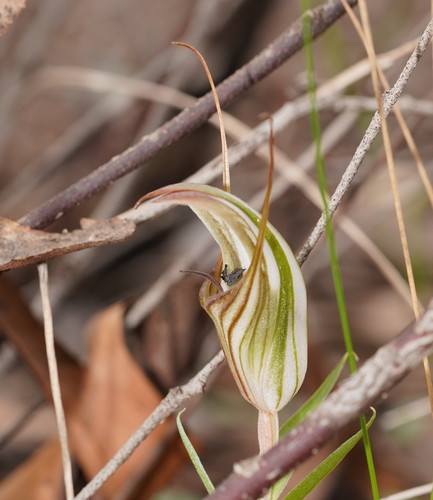
Pterostylis dolichochila is a terrestrial, perennial, deciduous herb that grows from an underground tuber. When not flowering, it produces a rosette of four to ten egg-shaped leaves. Each individual leaf measures 4–12 mm long and 3–8 mm wide. Flowering plants bear a single flower that is 20–25 mm long and 7–9 mm wide, held on a 50–150 mm high spike. Three or four stem leaves wrap around the flowering spike. The flowers are green and white with reddish-brown stripes. The dorsal sepal and petals are fused together to form a hood, also called a "galea", that covers the column. The dorsal sepal curves forward and ends in a sharp point or a thread-like tip 1–2 mm long. The lateral sepals are held closely against the galea, each has an erect, thread-like tip 15–20 mm long, and there is a broad, flat sinus between their bases. The labellum is 13–15 mm long, about 4 mm wide, brown, blunt, and curved, and it protrudes above the sinus. Flowering occurs between April and August. This orchid, commonly known as the long-tongued shell orchid, grows on calcareous sand and limestone, sometimes forming large colonies. It inhabits mallee areas in the southeast of South Australia, and the Little Desert and Big Desert regions of Victoria.