About Pterostylis daintreana F.Muell. ex Benth.
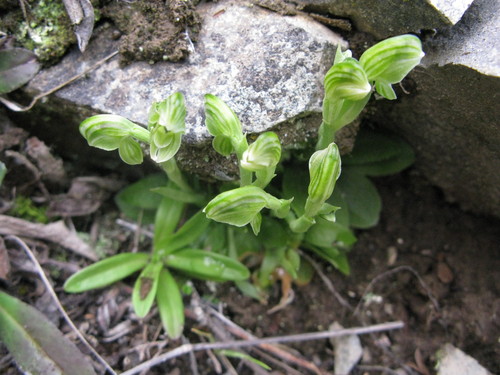
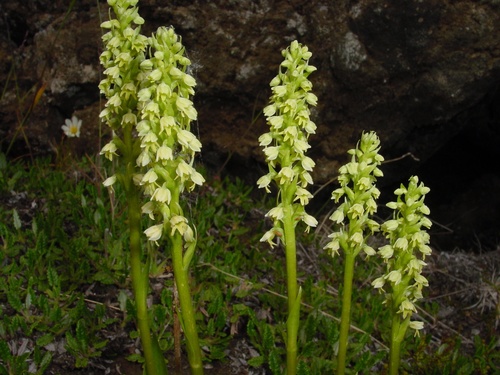
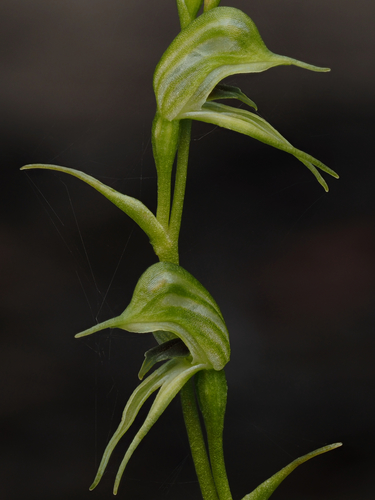
Pterostylis daintreana (also spelled Pterostylis daintreeana) is a terrestrial, perennial, deciduous herb that grows from an underground tuber. When it is not flowering, it produces a basal rosette of three to ten leaves. These leaves are egg-shaped to heart-shaped, measuring 6–24 mm long and 4–13 mm wide. When the plant is flowering, the flowering stem grows to 100–300 mm tall, and bears one or two rosettes on the side of the stem, three to five stem leaves, and between three and ten total flowers. Each flower is 14–17 mm long and 4–5 mm wide, with a translucent white base and dark green markings. The dorsal sepal and petals are fused together to form a hood, also called a "galea", that covers the column. The dorsal sepal ends in a thread-like tip 3–4 mm long. The lateral sepals are joined near their bases, then curve downwards; their narrow, elongated ends are 7–8 mm long and held parallel to each other. The labellum is about 4 mm long and 2 mm wide, dark brown, and has two large side lobes. Flowering of this species occurs from January to July. This species, commonly called Daintree's greenhood, grows in coastal areas and tablelands of New South Wales and southern Queensland, where it is found growing among small shrubs or on mossy rocks.