About Pterostylis cardiostigma D.Cooper
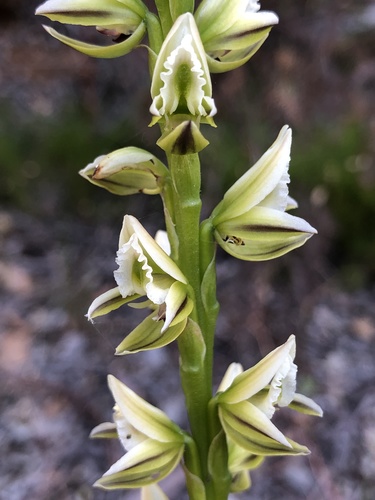
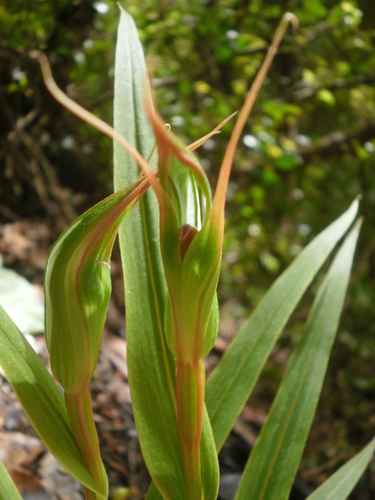
Pterostylis cardiostigma is a terrestrial, perennial, deciduous herb that grows from a large, heart-shaped underground tuber. The flowering stem bears between four and seven upright leaves, with the uppermost leaf positioned higher than the flower. The leaves are erect, linear to lance-shaped, measuring 80–280 mm (3–10 in) long and 10–20 mm (0.4–0.8 in) wide, and have a prominent red keel. A single flower is carried on a flowering stem 60–350 mm (2–10 in) tall; the flower is green with fine white stripes and pink or red tips. The dorsal sepal and petals are fused to form a narrow hood called a "galea" that covers the column, and the dorsal sepal is 5–10 mm (0.2–0.4 in) longer than the petals. The lower half of the galea is vertical, while the upper part curves forward but never reaches a horizontal position. The lateral sepals are more or less erect, extend much higher than the galea, and have long, narrow, red, thread-like tips. The labellum is curved, red, and pointed. Only visible when the flower is opened, the stigma has a characteristic heart shape that gives the species its name. Flowering occurs between October and December. This greenhood orchid grows in scrub and forest habitats on both the North and South Islands of New Zealand, and it is often found growing alongside P. banksii. The flowers of P. cardiostigma are very narrow and often do not appear to be fully open. Early in flower development, the labellum protrudes, which suggests that cross-pollination can occur. However, the stigma of this species is larger than that of other Pterostylis species, and pollinia often fall directly onto the stigma, meaning self-pollination also occurs regularly.