About Pterostylis banksii R.Br. ex A.Cunn.
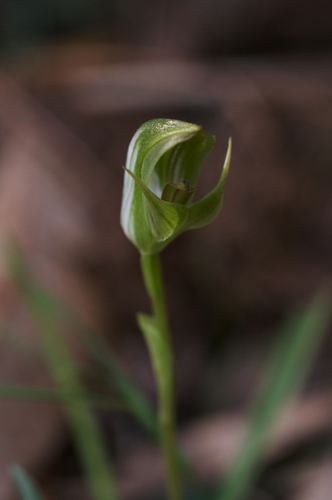
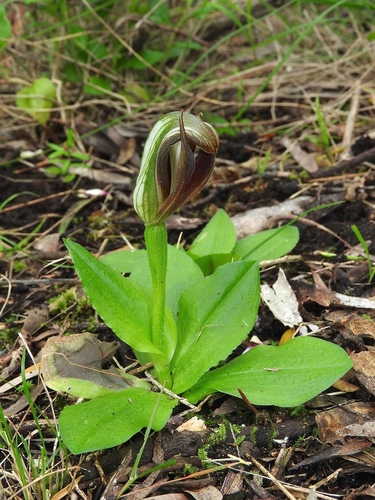
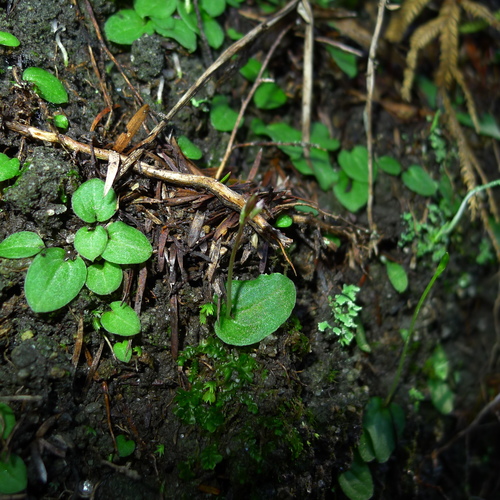
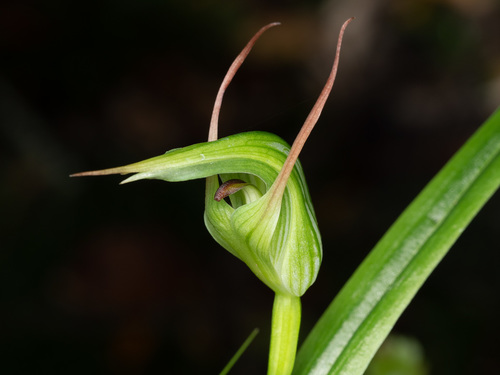
Pterostylis banksii is a terrestrial, perennial, deciduous herb that grows from an underground tuber and often forms colonies. Non-flowering plants produce a rosette of four to six oblong to broadly lance-shaped leaves. Flowering individuals bear four to six linear to lance-shaped leaves arranged along the flowering stem, with leaf shape varying by position on the stem. These leaves measure 50–250 mm (2–10 in) long and 10–20 mm (0.4–0.8 in) wide, and the uppermost leaf or leaves grow taller than the top of the flower. The flowering stem reaches 100–680 mm (4–30 in) in height, and typically bears just one green flower marked with translucent white stripes. The dorsal sepal and petals are fused together to form a hood, or 'galea', that covers the column. The dorsal sepal is 25–50 mm (1–2 in) tall, with a nearly horizontal tip that tapers into a long narrow point up to 25 mm (1 in) long. The lateral sepals taper into narrow points up to 20 mm (0.8 in) long, and are held erect or curved backwards. The labellum is curved, has a reddish tip, and extends above the notch (sinus) between the lateral sepals. Flowering takes place from September to December. This species grows in forest and shrubland, including shrubland and forest dominated by introduced plant species. It is found on New Zealand's North Island, South Island, Chatham Island, and Stewart Island.