About Pterostylis agathicola D.L.Jones, Molloy & M.A.Clem.
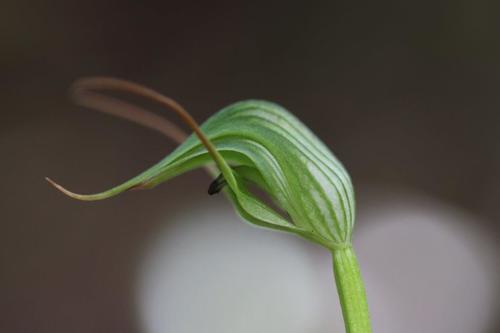
Pterostylis agathicola D.L.Jones, Molloy & M.A.Clem. is a terrestrial, perennial, deciduous herb that grows from an underground tuber. When it is not flowering, it produces a rosette of two or three dark green, linear to lance-shaped leaves. Each leaf measures 30–60 mm (1–2 in) long and 3–6 mm (0.1–0.2 in) wide. Flowering individuals produce a single flower 24–28 mm (0.9–1 in) long, borne on a stalk 100–350 mm (4–10 in) high that also bears three or four spreading stem leaves. The flowers are translucent white with green stripes and brownish tips. The dorsal sepal and petals are fused together to form a hood, called a "galea", that covers the column. The dorsal sepal is much longer than the petals, curves forward, and ends in a long, tapering tip. The lateral sepals are held erect, leaving a wide gap between them and the galea, with a deep narrow notch in the center of the sinus between their bases. The labellum is 9–11 mm (0.35–0.43 in) long, about 3 mm (0.1 in) wide, curved, colored dark green to brownish, twists prominently to the right, and protrudes above the sinus. Flowering occurs between July and October. This species, commonly called kauri greenhood, only grows in kauri forest, most often in leaf litter near large kauri trees. It occurs on New Zealand's North Island between the Te Paki Recreation Reserve, the Te Kauri Scenic Reserve, and the Kaimai Range.