About Pterospora andromedea Nutt.
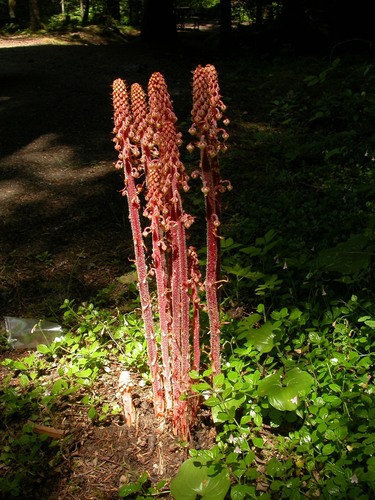
Pterospora andromedea, commonly called pinedrops, has only its fleshy, unbranched reddish to yellowish flower spike (raceme) visible above ground. This flower spike stands between 15 and 170 cm tall, and may occasionally reach 2 meters (6.6 feet) in height. The above-ground inflorescence stalks are shaped like an emerging asparagus spear, and usually grow in small clusters between June and August. The inflorescences are hairy and noticeably sticky to the touch, caused by glandular hairs that exude a sticky substance. The inflorescence is covered in leaves that are reduced to scale-like structures called bracts, which measure 2 to 3.5 centimeters long and 0.5 to 1 centimeter wide. The lower portion of the flowering stem is tightly covered in bracts, which become more widely spaced higher up the stalk. The upper portion of the inflorescence holds a series of downward-facing, urn-shaped flowers that can be white, yellowish, or rusty colored. Each flower has five sepals surrounding its base, measuring 4 to 6 millimeters long and 2 to 3 millimeters wide. The fused petals that form the corolla measure 6 to 9 millimeters in length. The fruit is a five-lobed capsule 7 to 10 millimeters wide. Capsules contain large numbers of very small seeds that have thin papery wings much wider than the seed itself. Pterospora andromedea spends most of its lifecycle as a mass of branching roots that form round root balls. The roots of other plants may grow into these root balls, but no vascular connections form between them. The maximum total volume of a root ball is 150 to 200 cubic centimeters. The inflorescence grows from buds on horizontally growing roots. After fruiting finishes, the flowering stems dry out and persist in the forest for a long time. Pinedrops are most often confused with mycoheterotrophic coralroot orchids in the genus Corallorhiza, but coralroot flowers are bilaterally symmetrical, while pinedrop flowers are radially symmetrical. Pterospora andromedea is native to North America, ranging from Alaska down to central Mexico. It has two separate populations, a larger one in western North America and a smaller one in eastern North America, divided by the Great Plains. In Canada, it occurs in the western provinces of British Columbia, Alberta, and Saskatchewan, and in the eastern provinces of New Brunswick, Ontario, Prince Edward Island, and Québec. In the western United States, it is widespread across Arizona, California, Colorado, Idaho, Montana, Nevada, New Mexico, Oregon, South Dakota, Utah, Washington, and Wyoming; it has also been reported in Sioux County, Nebraska, and recorded in Texas without specific county-level distribution data. The eastern North American population occurs in Michigan, New Hampshire, New York, Vermont, Wisconsin, and possibly Pennsylvania. Pinedrops grow across many Mexican states, including Chihuahua, Coahuila, Durango, Hidalgo, Mexico City, Mexico State, Morelos, Nuevo Leon, Oaxaca, Puebla, Sonora, Tlaxcala, and Veracruz. It is also very rarely found at the highest elevations of Sierra de San Pedro Mártir in Baja California. In the western United States, it mainly grows under conifer trees in areas with deep needle accumulations and dry to moderately moist soils, but may also grow under some oak species. It is specifically found in Rocky Mountain Douglas-fir forests, ponderosa pine forests, and the Sierra Nevada upper montane forest, as well as under eastern white pines and balsam firs around the Great Lakes, especially on forested dunes. Pinedrops do not photosynthesize, and are classified as a protocarnivorous plant: their sticky stems trap small insects, and enzymes break the insects down to access nitrogen. While pinedrops are not a typical hummingbird food plant, broad-tailed hummingbirds (Selasphorus platycercus) have been observed drinking nectar from pinedrop flowers. Pinedrop seed stalks are occasionally collected to use as long-lasting ornaments in dry floral arrangements. Though plant collectors value pinedrops for their attractive flowers, the species' very specific requirements for its fungal host make it practically impossible to transplant.