About Pterospermum acerifolium (L.) Willd.
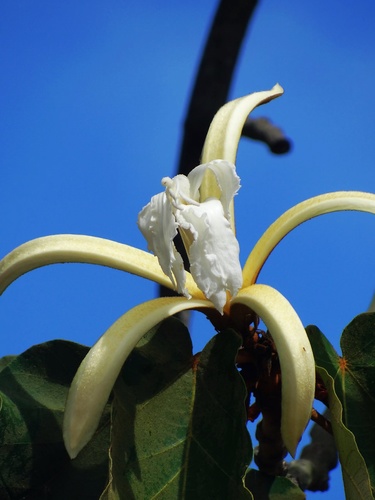
Pterospermum acerifolium (L.) Willd., commonly called the bayur tree or dinner plate tree, has grey, fairly soft bark. Small twigs and new growth are often rusty-brown and sometimes have a feathery appearance. Its leaves grow in an alternate arrangement, are palmately ribbed with stipules, and have a peltate blade base where the petiole inserts at the center of the leaf. Leaf shape ranges from oblong and broadly obovate to ovate; leaf edges are typically dentate (toothed) or irregularly lobed. Many leaves droop downward, making the tree look like it is wilting even when it has enough available water. The upper leaf surface is dark green and glabrescent; leaves have a rough, rubbery texture that limits moisture loss in hot climates, and do not tear even when crumpled. The lower leaf surface ranges from silver to rust in color and is pubescent. This tree’s pollen is spherical with spikes, and measures approximately 60 microns across. Bayur trees produce large, white, finger-shaped flowers in spring. Flowers start as a single long bud, and separate into five more slender sepals as they mature, with each sepal growing up to seven inches long. The flower’s sepals curl outward around the white and gold stamen at its center. Flowers are nocturnal and exceptionally fragrant, which suggests they attract moths for pollination. After successful pollination, the tree produces a hard, rough-textured capsule fruit that is sometimes covered in brown hairs. Fruits take a very long time to fully mature, up to an entire year. When the capsule splits open, it releases a large number of winged seeds. Due to its long reproduction period, bayur trees can be out-competed by faster growing plants. It is not widely distributed or common in natural environments, but it is a popular plant for gardens and landscaping. The common name dinner plate tree refers to the use of its large mature leaves, which can reach up to 35 centimeters in both length and width. These leaves can be used directly as dinner plates, or as packaging and storage for wrapping materials. In India, the leaves are shaped into standard dinner plates and soup bowls using moulds, and some are even stitched together with twigs. In Burma, they are also used as a surface to dry tobacco. Leaves can also act as a primitive reinforcement for roofs to prevent leaks. The pubescent lower leaf surface is said to stop bleeding, and leaves can be used as tinder to start fires. Bayur tree flowers provide a pleasant fragrance and can repel insects. They also have several medicinal uses: they can be used to prepare an effective tonic, and are used to treat inflammation, ulcers, blood problems, and tumors. The tree’s reddish soft wood is used for planking. While it is not considered very strong due to its softness, it is very durable and somewhat flexible, which makes it ideal for planking and wooden boxes. Bayur trees also serve a cultural function: local Hindu people use the plant for religious purposes. Its bark is also used to treat scabies, and is included as an ingredient in topical lipstick preparations.