About Pteronetta hartlaubii (Cassin, 1860)
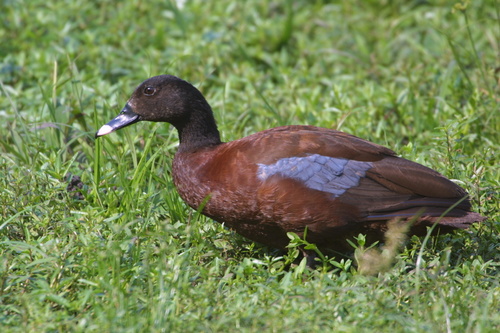
Hartlaub's duck, scientifically named Pteronetta hartlaubii (Cassin, 1860), is a monotypic species with no accepted subspecies. On average, adult individuals measure 56 to 58 centimetres (22 to 23 inches) in length. Juveniles have feathers with pale tips on the breast and abdomen. Fully developed adult plumage, which is overall red-brown with a black head that may have white markings on the crown, is reached after six months. The amount of white on an individual’s head varies between ducks. Adult males weigh between 925 and 1,140 grams (32.6 and 40.2 ounces), have reddish-brown eyes, and are more likely to have extensive white on the crown. Adult females weigh between 770 and 805 grams (27.2 and 28.4 ounces), rarely have any white on their heads, and have dark red eyes. Both sexes have a distinctive blue patch on the wing that sets them apart from most other waterfowl. During the mating season, the base of the male’s bill enlarges. This species is a resident duck found in equatorial West and Central Africa. Its range extends from Guinea and Sierra Leone, east through Nigeria to South Sudan, and south to Gabon, Congo and Zaire. It lives year-round in parts of central western Africa including Cameroon and the Democratic Republic of the Congo. Hartlaub's duck inhabits swampy marshes, tropical forests, savanna areas, rivers, and streams. In Liberia, it also lives in mangroves, and it only gathers in flocks here between January and May.