About Pteroglossus torquatus (J.F.Gmelin, 1788)
General Appearance
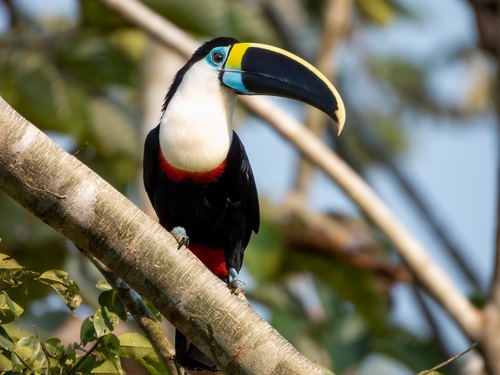
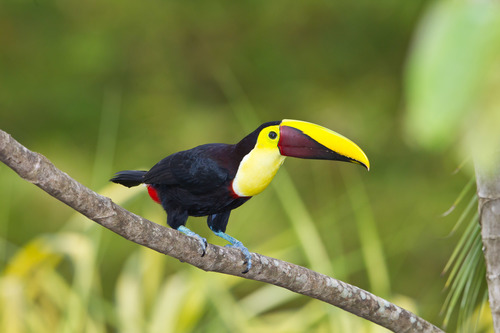
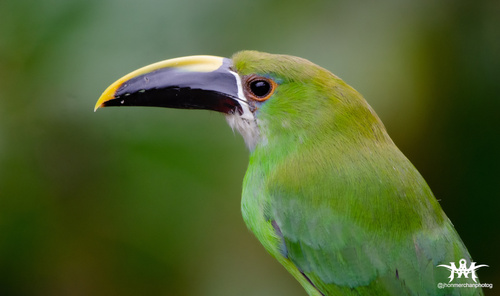
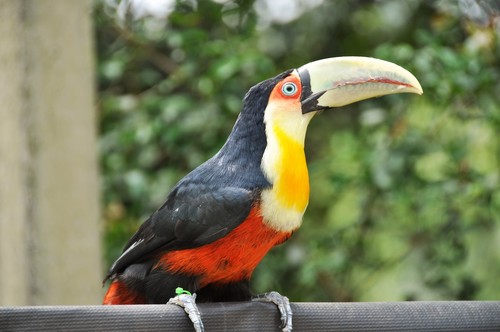
Like other toucans, the collared aracari (Pteroglossus torquatus) is brightly marked and has a large bill.
Size
Adults measure 38 to 41 cm (15 to 16 in) in length and weigh 175 to 250 g (6.2 to 8.8 oz).
Sexual Dimorphism
Males and females share the same bill and plumage coloration, but the female's bill is shorter than the male's.
Subspecies Bill Similarity
The bills of the three recognized subspecies are similar to one another.
Bill Base Feature
The adult's bill has a narrow vertical white line at its base.
Maxilla Characteristics
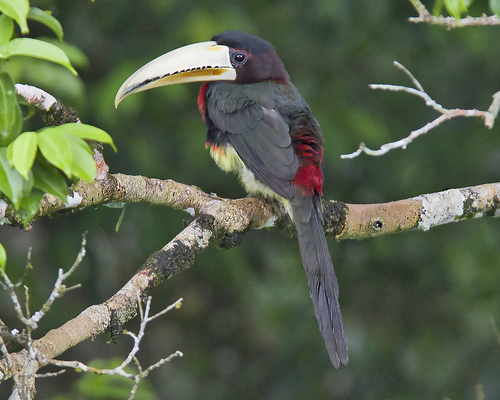
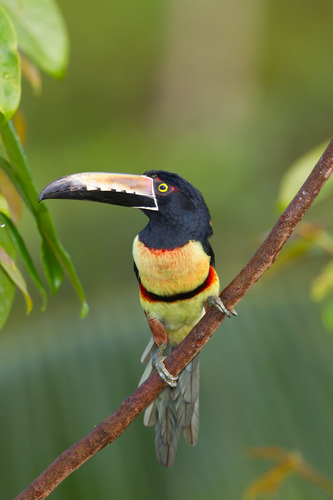
Its maxilla is buffy white, darkening to dull reddish brown at the base; the tip and culmen are black, and the maxilla has black and yellowish white notches.
Mandible Characteristics
The mandible of the bill is entirely black.
Nominate Subspecies Upperparts
Adults of the nominate subspecies have mostly glossy black upperparts, with a narrow cinnamon rufous collar at the base of the nape and bright red lower back, rump, and uppertail coverts.
Nominate Subspecies Head and Underparts
Their head, throat, and uppermost breast are greenish black, while their lower breast, belly, and undertail coverts are yellow.
Nominate Subspecies Breast and Belly Markings
The breast has a variable red wash and a black spot at its center, and the upper belly is crossed by a narrow red and black band.
Nominate Subspecies Thigh Color
Their thighs are colored cinnamon to rufous.
Juvenile Plumage
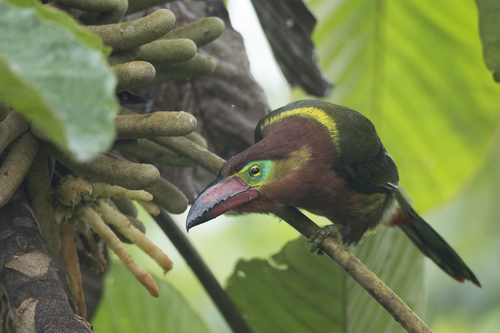
Juvenile collared aracaris are much duller than adults, with a sooty-black head and chest and brownish olive upperparts.
Juvenile Markings
Their red rump and yellow underparts are paler, and the breast spot, belly band, and bill pattern are all indistinct.
P. t. erythrozonus Traits
Subspecies P. t. erythrozonus is similar to the nominate subspecies but is smaller, and has a much smaller breast spot or no breast spot at all.
P. t. nuchalis Traits
P. t. nuchalis is also similar to the nominate, but its breast spot is usually larger and the white basal line on the bill is wider.
Most Common Call
The species' most common call is described as "a high, sharp, squeaky note, such as seek, pseek, pink or penk, or a two-parted pi-cheet or squi-zeek."
Other Vocalizations
Collared aracaris also make a "purr" and an "aggressive, rasping grhhrr".
Potential Non-Vocal Sound
A reported rattle call written as "bddddddt" may actually be non-vocal.
Flight Sound
The collared aracari's wings make an audible whir during flight.
Subspecies Distributions
The three subspecies have separate distributions: P. t. torquatus ranges from east-central Mexico south through Central America to just into northwestern Colombia, and is not found on the Yucatán Peninsula; P. t. erythrozonus occurs in southeastern Mexico including the Yucatán Peninsula, Belize, and Petén in northern Guatemala; P. t. nuchalis is found in northern Colombia and northern Venezuela.
Habitat Types
The collared aracari inhabits the interior and edges of evergreen primary forest and mature secondary forest, and also occupies coffee, cacao, and fruit plantations.
Semi-Arid Habitat
In the semi-arid parts of northern Colombia and Venezuela, it also occurs in gallery forest.
Elevation Range
It can be found at elevations from sea level to approximately 1,000 m (3,300 ft).