About Pterocaulon sphacelatum (Labill.) F.Muell.
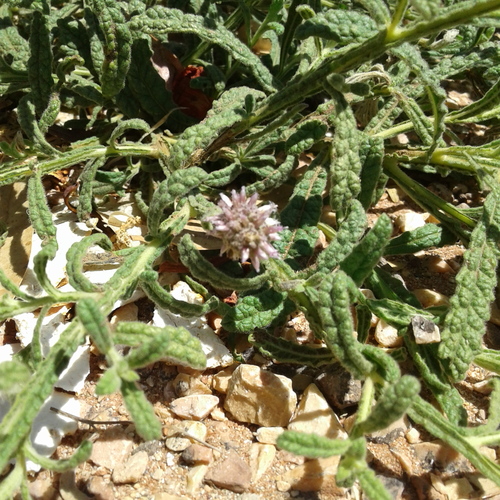
Pterocaulon sphacelatum (Labill.) F.Muell., commonly called applebush, is a small perennial understory herb or shrub that grows 20 to 100 cm (7.9 to 39.4 in) high. It has stiff upright stems covered in short brownish woolly or short, dense matted hairs. Its leaves are usually oblong to lance-shaped, with pointed or nearly pointed tips; they measure 1 to 4 cm (0.39 to 1.57 in) long and 3 to 15 mm (0.12 to 0.59 in) wide. The leaves are green and hairy on both surfaces, somewhat wrinkled, and have a distinctive mid-vein. Upper leaves are slightly scalloped or have smooth entire margins, while lower leaves are toothed.
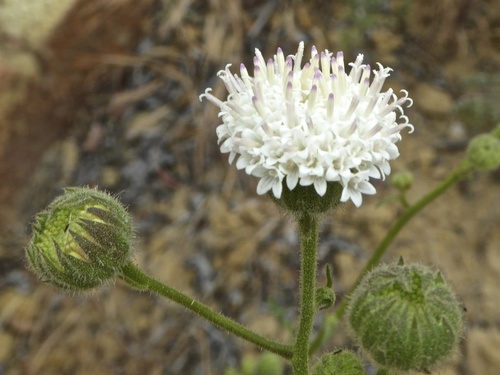
The plant produces solitary flower heads that are oval to globe-shaped, 0.8 to 2 cm (0.31 to 0.79 in) long and 10 to 20 mm (0.39 to 0.79 in) in diameter. The flower heads are either sessile or borne on a stalk. Outer bracts are spoon-shaped, while inner bracts are linear-lance shaped and range in color from whitish to pink; the florets are pink to purple. Flowering occurs from July to October. The fruit is a brown, spindle-shaped achene about 0.7 to 2 mm (0.028 to 0.079 in) long, slightly ribbed, and covered in approximately 15 to 20 bristles.
Applebush is an aromatic plant that is used in Australian Aboriginal medicine. It grows in a variety of habitats, mostly on occasionally flooded locations and disturbed sites including roadsides. It is found in Western Australia, Queensland, New South Wales, Victoria, and the Northern Territory.