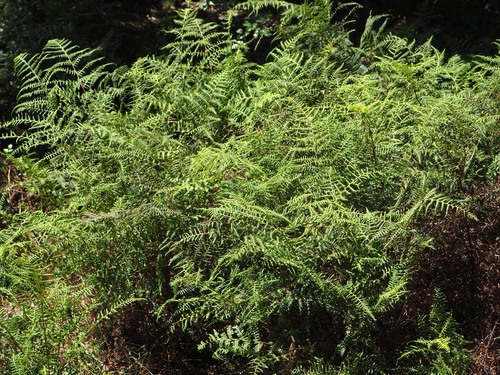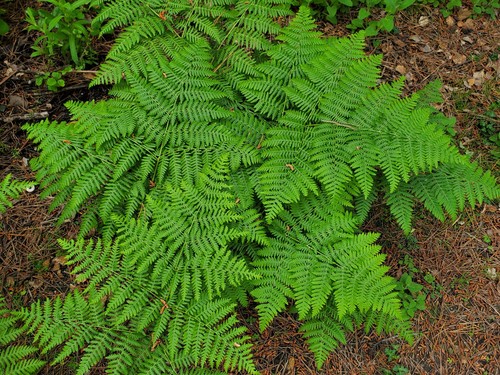
About Pteridium aquilinum subsp. latiusculum (Desv.) Hultén
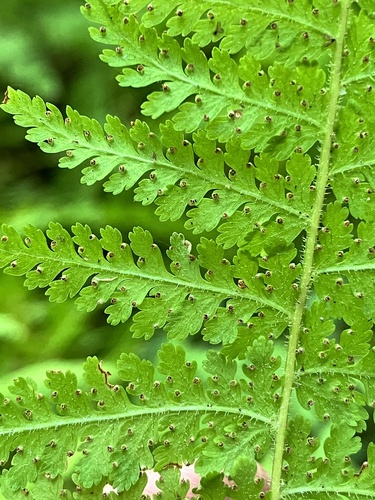
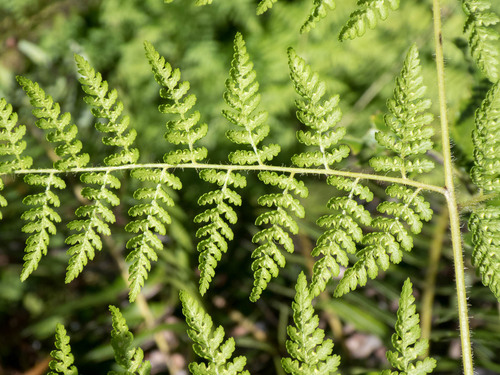
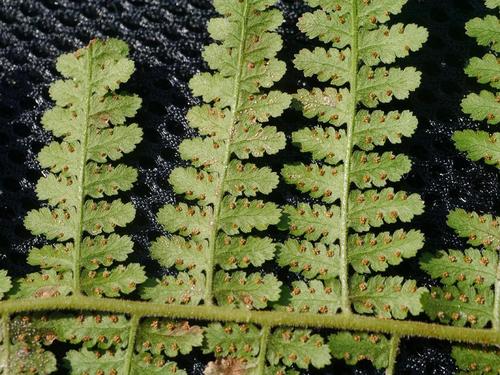
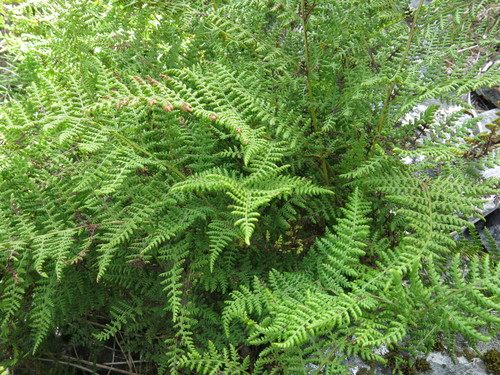
Pteridium aquilinum subsp. latiusculum, commonly called common bracken, is a herbaceous deciduous perennial plant that dies back to ground level each autumn. Its large, roughly triangular fronds grow individually upward from an underground rhizome, reaching 0.3–1 metre (1–3+1⁄2 feet) in height. The main stem, or stipe, can reach up to 1 centimetre (1⁄2 inch) in diameter at its base. The underground rhizome grows up to 3.5 metres (11+1⁄2 ft) deep, around 5 cm (2 in) in diameter, and up to 15 m (50 ft) long. Because new fronds regrow each spring from this shared underground rhizome, this subspecies typically forms dense colonies of genetically identical fronds. These colonies can reach up to 650 years of age, while individual rhizomes live up to 72 years. One colony studied by Eino Oinonen at Raakkyla, North Karelia, Finland was 489 m (1,604 ft) in diameter, and estimated to be over 1400 years old based on its growth rate. At the start of the spring growing season, fiddleheads first emerge from the rhizome. The density of growth and large area covered by a single rhizome improves its biological success when producing new growth. New growth appears as vertical coiled stalks covered in silver-grey hairs, which can grow to a metre or more in height before unfurling into mature fronds. Bracken is native to Europe, Eastern Asia and North America, and now has an almost cosmopolitan distribution. In the Americas, it occurs across the continental United States, and in the Canadian provinces of Ontario, Quebec, and Newfoundland. The northern edge of its range reaches southern Alaska, while its southern extent reaches northern Mexico and the Greater Antilles in the Caribbean. It grows as a weed in acidic upland pastures of northwestern Europe. It grows in pastures, deciduous and coniferous woodlands, and hillsides, and prefers acidic soils. It is an adaptable species that readily colonises disturbed areas, and can grow aggressively even within its native range; for example, it has invaded heather (Calluna vulgaris (L.) Hull) stands on the North Yorkshire moors in England. In Ireland, it is found in open woodland and sandy pastures. Reproduction occurs via spores held in sporangia, which form sori arranged in narrow brown bands on the underside of fronds. Spores develop over July, August, and September. This plant contains the carcinogenic compound ptaquiloside. Ptaquiloside is known to cause haemorrhagic diseases in ruminants, and tumours and haematological problems in non-ruminants, and it has been correlated with oesophageal and gastric cancer in humans. Chronic consumption of bracken is also associated with squamous cell carcinomas of the upper digestive tract (UDT) in cattle, with the most aggressive and serious tumours located in the caudal (lower) UDT. High rates of stomach cancer are seen in Japan and North Wales, where young bracken stems are eaten as a vegetable, though it remains unknown whether bracken contributes to this cancer, or if the association stems from another unrelated cause. Consumption of ptaquiloside-contaminated milk is thought to contribute to human gastric cancer in the Andean states of Venezuela. Bracken spores have also been implicated as carcinogens. Consumption of contaminated water or meat from animals that have eaten bracken may also be dangerous. However, ptaquiloside is water-soluble, and its levels are reduced by soaking bracken in cool water. Korean and Japanese cooks have traditionally soaked bracken shoots in water and ash to detoxify the plant before eating. Ptaquiloside also degenerates at room temperature, which is why rat studies of the toxin use samples stored at −20 °C (−4 °F). At boiling temperature, the carcinogen denatures almost completely. Salt and baking soda also help volatilize the toxin. Selenium supplementation has been suggested to both prevent and reverse the immunotoxic effects induced by ptaquiloside from Pteridium aquilinum. Despite its confirmed toxicity, Pteridium aquilinum has a long history of human consumption across much of the world, as it is the fifth most widely distributed common weed species globally. This combination of toxicity and wide distribution has led to varied cultural attitudes toward consuming the plant. In the United Kingdom, where P. aquilinum grows very successfully, the rhizome was consumed during and after World War I. The Royal Horticultural Society now explicitly advises against consumption of the plant due to its toxicity. Bracken is widely eaten as a vegetable in Korea, Japan, the Russian Far East, and parts of China, where it has historically been one of the most important wild vegetables harvested. When people from these regions immigrate to new areas, they can usually access bracken locally due to the species' global ubiquity. In Korea, bracken is called gosari. It is soaked, parboiled, stir-fried, and commonly served as a side dish called namul, and it is also a classic ingredient in bibimbap. In Japan, bracken is called warabi (蕨, ワラビ); a jelly-like starch made from it is a key ingredient in the chilled dessert warabimochi. As a type of sansai (mountain vegetable), young bracken shoots are steamed, boiled, or cooked in soups. Shoots are also preserved in salt, sake, or miso. Bracken shoots have been used to produce beer in Siberia, and by indigenous peoples of North America. The rhizome can be ground into flour to make bread. In the Canary Islands, the rhizome was historically used to make a porridge called gofio. In the Mediterranean region, bracken leaves are used to filter sheep's milk and store freshly made ricotta cheese. The Nooksack place name translates to "always bracken fern place" in the Nooksack language, and the Nooksack people and other Pacific Northwest tribes ate the plant's rhizome extensively. Young bracken fronds are easy to harvest and should be cooked for 30 to 60 minutes before eating. Mature bracken is toxic due to the presence of thiaminase, a compound that can be destroyed by cooking. Consumption should be avoided by people without sufficient preparation skill. In Finnish traditional medicine, bracken has been used for a range of remedies: Elias Lönnrot recommended using a powder made from the plant's roots to drive away maggots. A bracken decoction was used to treat stomach problems, gout and joint pain. Leaves were used as mattress filling, as they were believed to reduce rheumatic pain and drive away vermin.