About Ptelea trifoliata L.
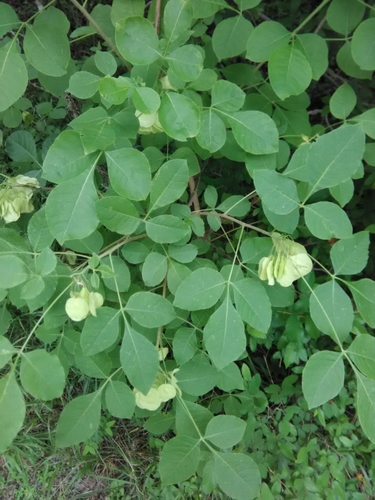
Ptelea trifoliata L. is most often a shrub with a few spreading stems, or sometimes a small tree. It reaches roughly 6–8 m (20–26 ft) in height, and has a broad crown. Its bark ranges from reddish brown to gray brown, marked by short horizontal lenticels that appear as warty corky ridges, and the bark becomes slightly scaly with age. This plant has an unpleasant odor and a bitter taste. Its branchlets are dark reddish brown and shiny, and are covered in small excrescences. Twigs are slender to moderately stout and brown, with deep U-shaped leaf scars, and short, light brown, fuzzy buds. It also has thick fleshy roots. This species is native to North America. Its northern native range extends to Ontario and Quebec, Canada. It is native across much of the eastern and southwestern United States, though it is not present in some areas of the Upper Midwest and is rare across most of New England. Its southern native range reaches into Mexico. It occupies a wide variety of natural habitats. In the Southeastern United States, it is most commonly found in rocky forests growing in both moist and dry soil, and is often associated with calcareous or mafic substrates. In the Midwest, it can be found in habitats including forests, savannas, prairies, glades, and sand dunes. In Arizona, it is common in canyons. In its ecology, larvae of the giant swallowtail butterfly Papilio cresphontes feed on its leaves. Treehoppers in the genus Enchenopa infest its branches, laying white frothy masses of eggs on the undersides of branches. Multiple ant species tend to these treehoppers, including Camponotus pennsylvanicus, Formica montana, and Formica subsericea. A number of bee species have been recorded visiting the flowers of Ptelea trifoliata, also called wafer ash: these include Agapostemon virescens, Andrena commoda, Andrena crataegi, Andrena cressonii, Apis mellifera, Bombus auricomus, Bombus bimaculatus, Bombus impatiens, Ceratina calcarata, Ceratina dupla, Ceratina mikmaqi, and Lasioglossum imitatum. Ptelea trifoliata has multiple traditional uses: Native American peoples use it as a seasoning and as an herbal medicine to treat a range of ailments. Many cultivars have been developed for ornamental planting in parks and gardens. The golden-leaved cultivar 'Aurea' has received the Royal Horticultural Society's Award of Garden Merit. In the 19th century, German immigrants to Texas used this plant's seeds as a substitute for hops during beer brewing, which gave the species its common name.