About Psyllobora vigintiduopunctata (Linnaeus, 1758)
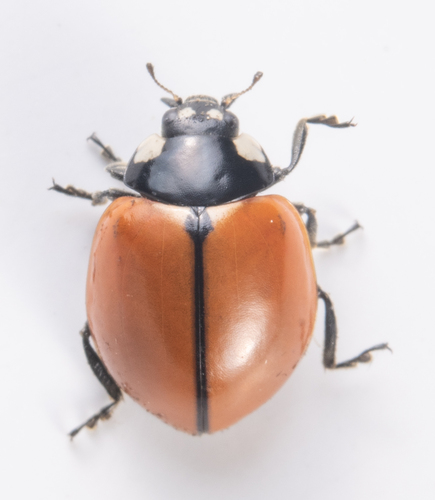
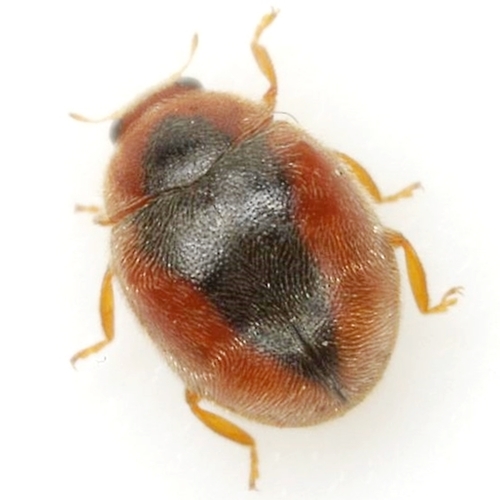
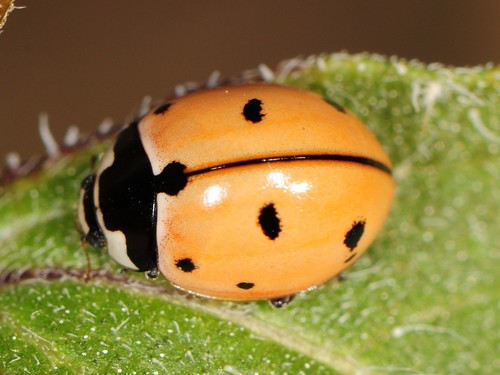
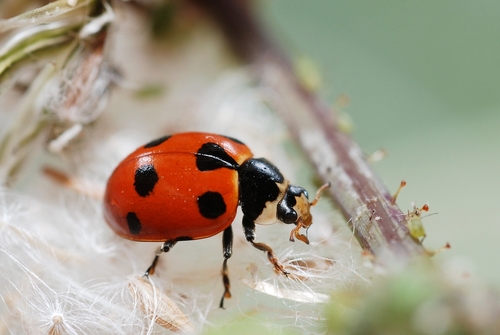
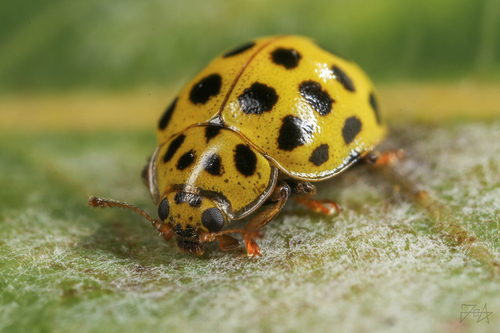
Psyllobora vigintiduopunctata, commonly called the 22-spot ladybird and often abbreviated to Psyllobora 22-punctata, was previously classified under the name Thea vigintiduopunctata. It is a common, 3–5 mm long ladybird native to Europe. This species was first documented in Germany in 1874, found on Astragalus leaves consuming the hyphae of Erysiphe holosericea. Its elytra are yellow and marked with 22 black spots, while its pronotum is yellow or white with 5 black spots. This is the only ladybird species in Britain and Ireland where all three life stages share very similar colouring and patterning; pupae and larvae resemble adult forms, which makes the species conspicuous and simple to identify. Unlike most other ladybirds that eat aphids, P. 22-punctata feeds on mildew, especially mildew growing on umbellifers and low-growing shrubs. The 22-spot ladybird is most easily found among low vegetation. It has occasionally been spotted in woodlands, on the lower branches of young trees, and in some coastal areas. In a 1960–1965 survey conducted by G.I. Savoiskaya in South-Eastern Kazakhstan, up to 500 individuals were found overwintering together in leaf litter at the bases of birches, hawthorns, and wild apple trees. These overwintering groups were recorded at elevations between 1000 metres and 2000 metres above sea level. The Royal Botanic Gardens, Kew officially recorded its first 22-spot ladybird in 1969, and published this finding alongside many other new additions to the institution's wild flora and fauna records. The hemolymph of the 22-spot ladybird contains a dimeric alkaloid called psylloborine A, which has unique structural features. This compound highlights the species' complex chemical defenses and evolutionary adaptations. Psyllobora vigintiduopunctata occupies a wide range of habitats, including semi-open and maintained areas. It is a low-dwelling species, found most often in grassy areas such as meadows, pastures, fields, yards, parks, gardens, forest edges, and open woodlands. Unlike other ladybird species that live on tree leaves, this species is never found more than 1 metre above ground. It becomes very active and collectible in April. Its most preferred host plants are cowparsley, Senecio jacobaea, and Cirsium arvense, though large numbers of specimens are usually found on flowering plants and low shrubs. It can also be discovered by beating oak foliage, and occurs on small trees. Additionally, this species is the namesake of Finnish indie rock band 22-Pistepirkko.