About Psychotria tenuifolia Sw.
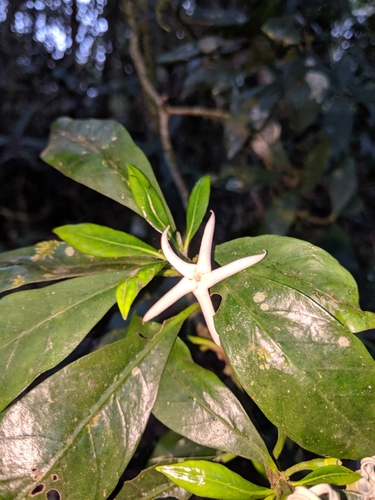
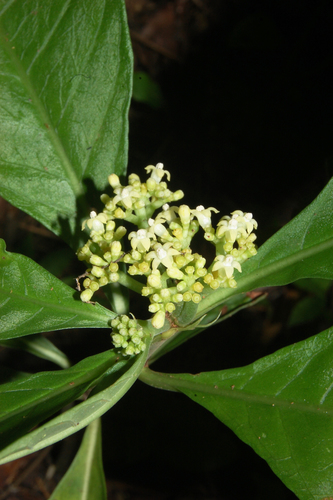
Psychotria tenuifolia Sw. is an evergreen shrub or small tree. This species can be identified by its dull or blue-green leaves, which measure 4–7 inches (100–180 mm) long. Its leaves are opposite, simple, and have pinnate venation, with one stipule forming between each pair of leaves. Unlike many other Psychotria species, it does not have domatia, and it produces terminal inflorescences that grow from the end of a stem rather than from the base of a leaf. When blooming, its small white flowers grow in clusters, have 5 petals, and show radial symmetry. Its fruits are red, orange, or yellow, with thin skin and a single central seed. This species is both heterostylic and hermaphroditic: individual flowers on the same plant develop stamens of different lengths to reduce self-fertilization, and each single flower contains both female and male reproductive parts. Psychotria tenuifolia grows in moist, shaded regions, and it is native to tropical and subtropical moist areas including Florida, Puerto Rico, Nicaragua, Cuba, Brazil, and the Caribbean. It propagates and thrives in moist, well-drained sandy or limestone soils, and can grow in either acidic or preferably alkaline pH conditions. Its suitable hardiness zones are 9A, 9B, 10A, 10B, and 11. Its seeds are dispersed by birds including mockingbirds, and it is assumed to be pollinated by insects and hummingbirds. While other plants in this family are most commonly used for their coffee seeds, Psychotria tenuifolia has documented medicinal uses. It has a history of traditional use as a Caribbean home remedy to treat colds, fevers, stomach sickness, asthma, swelling, sores, tumors, and skin fungus. Additional sources note that the species can also be used to stop hemorrhaging.