About Psychotria capensis (Eckl.) Vatke
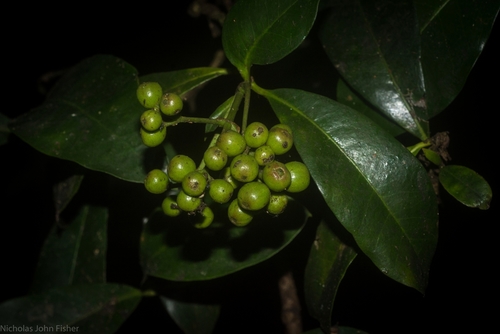
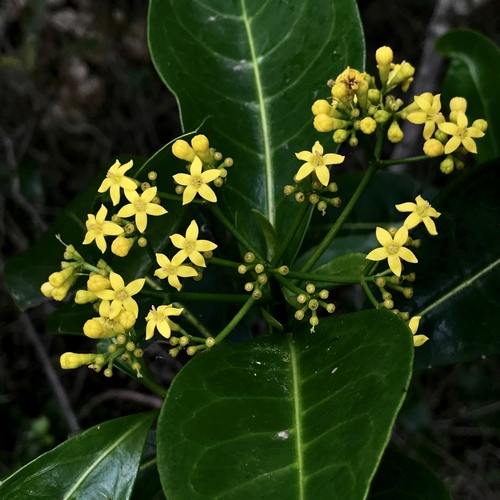
Psychotria capensis (Eckl.) Vatke usually grows as a shrub, and sometimes reaches the size of a small tree. It typically reaches 3 to 8 meters (10 to 15 feet) tall, with a stem diameter of 3 to 6 inches. It has a slender trunk with horizontal branches, pale brown bark, and the timber is often crooked and forked. The wood is hard, fine-grained, and yellowish-brown in colour. Its leaves are evergreen and grow in opposite arrangements, often drooping. They are large, leathery, and elliptic to obovate, ranging from 70-150 mm (3-6 inches) long by 15-60 mm (1/2 to 1 1/2 inches) wide. They are dark green and glossy or shining above, paler below, and glabrous on the upper surface; they may be either glabrous or pubescent on the lower surface. Leaf shapes can also be widely lanceolate or obovate-oblong, with short petioles, distinct venation, and a rounded or bluntly pointed apex. Stipules are shortly ovate from a broad base, with a blunt point. Yellow flowers grow in terminal, trichotomously branched panicles 1 to 4 inches (around 80 mm) across from August to January. The calyx tube is short with minute 5 teeth. The yellow corolla is shortly tubular, with a 5-parted limb and a hairy throat. Stamens sit in the corolla throat with shortly oblong anthers, and the pistil is bifid. John Medley Wood noted that this species has dimorphic flowers, with two different forms growing on separate plants. In the long-styled form, stamens are sub-exserted and the style is exserted; in the long-stamened form, stamens are exserted and the style is included. After flowering, it produces clusters of pea-sized, shiny yellow fruits that turn red or black when ripe. Ripe berries are around 3 lines in diameter, numerous, and leave only a scar where the calyx was detached. This species occurs along the south and east coasts of South Africa, ranging from Knysna through Eastern Cape and KwaZulu-Natal. It is also found in eastern Mpumalanga and Limpopo provinces, and extends north into Zimbabwe and Mozambique. It grows at elevations from sea level up to 1,500 m, in habitats including evergreen forests, forest margins, dune scrub, river courses, and rocky outcrops in high rainfall grassland.