About Psoralea swartbergensis (C.H.Stirt.) C.H.Stirt.
Psoralea swartbergensis (C.H.Stirt.) C.H.Stirt. is a small spreading shrublet, with numerous slender stems covered in short hairs that point toward the growing tip. Longer, spreading hairs are interspersed among these short hairs, particularly on the stem ribs.
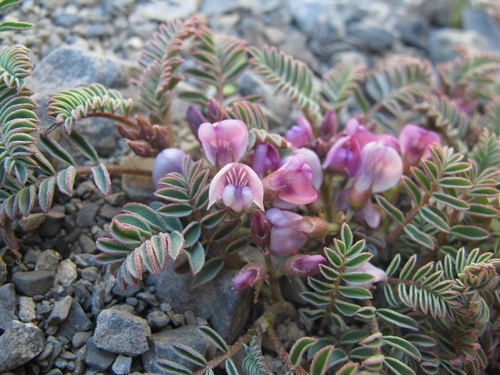
At the base of each leaf is a pair of pointed stipules, which are oval or shortly oblong in shape. These stipules measure 5–7 mm long and 18–30 mm wide, are hairless on their inner surface and silky hairy on their outer surface, and are partially merged with the base of the hairy petiole. The petiole itself is about 5–7 mm long, and carries three flat, elliptical leaflets at its tip. Each leaflet is 15–22 mm long and about 6–8 mm wide, with a blunt base, an entire margin, and a tip that ends abruptly in a small, sharp, recurved point extending from the midrib. The surface of the leaflets is covered in silky hairs, with denser hair growth on the lower surface, especially along the veins. Leaflets produced later in the growth season are larger than those produced earlier, and the two lateral leaflets are smaller than the central leaflet.
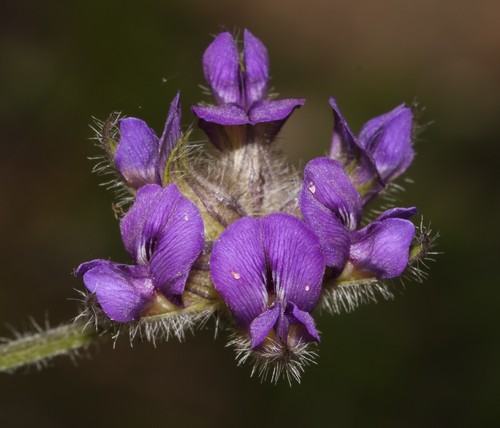
Flowers of this species are arranged in roundish heads of 6 to 15 flowers, growing on 5–20 cm long peduncles that emerge from leaf axils. Each head contains 2 to 5 groups of three flowers. The lowest triplet of flowers is subtended by a semi-circular, hairy bract that is divided into 2 or 3 teeth. Bracts become progressively narrower for triplets positioned closer to the tip of the peduncle. Each individual flower sits on a 1.5–2.0 mm long pedicel, and is subtended by a very narrow bract. Flowers are 8–11 mm long overall.
Five hairy sepals, 11–13 mm in total length, are merged into a 2.5–3.0 mm long calyx tube at the base, and end in separate teeth that enclose the petals in bud. The lower tooth, which sits beneath the keel, is 9–10 mm long and 3.0–3.5 mm wide, and has prominent netted veins. The remaining four teeth are all curved, narrowly triangular, 5.5–6.0 mm long and 1.5–2.0 mm wide. Like all members of the Faboideae subfamily, the corolla is zygomorphic, forms a specialized structure, and is made up of 5 free petals. Young corollas are mauve, and fade to purple as they age. The large upper petal, called the banner or standard, envelops the other petals in bud. It is slightly netted, teardrop-shaped, 8–10 mm long and 5.0–6.5 mm wide, and narrows into a 3 mm long claw at its base. The standard gradually curves back along its length. The two adjacent lateral petals, called wings, are 9.5–10.0 mm long, with a 6–7 mm long blade that is 2.2–2.5 mm wide. They have 15-18 irregularly parallel ridges as sculpturing, and an ear-shaped appendage that extends beyond the attachment to the claw. The wings are longer than the two bottom petals (which together form the keel) and enclose them.
The two keel petals have long claws and together form a boat-like structure. Each keel petal is divided into a claw and a blade; the blade is 8 mm long and 2 mm wide, with a rounded tip. The keel encloses 10 filaments: nine of the filaments are fused and measure 8 mm long, while the tenth filament is loosely attached for half its length and measures 7.5 mm long. Anthers are alternately attached to their filaments at the base and at midlength. The filaments surround a swollen style 8 mm long. At the base of the style is an ovary 1.5 mm long that bears some glands. The style curves upwards for about 2 mm before ending in a pin-shaped, papillose stigma.
Psoralea swartbergensis is classified as a near-threatened species. It is known from only six locations, where it may face threats from competition by invasive plants. It grows on sandstone slopes along seeps and on the banks of streamlets, in the Sandstone Fynbos vegetation type.