About Psophocichla litsitsirupa (A.Smith, 1836)
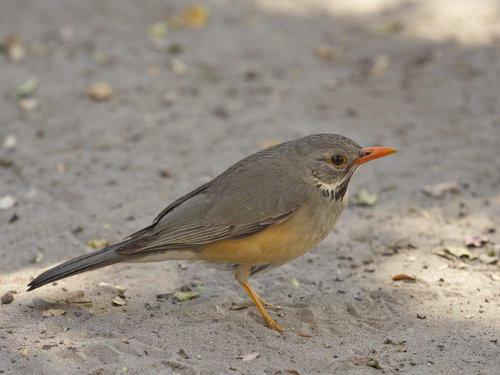
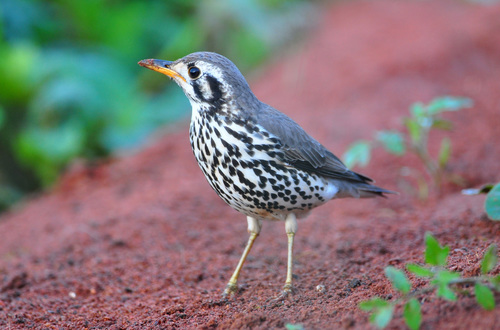
The groundscraper thrush, scientifically named Psophocichla litsitsirupa, is a passerine bird in the thrush family Turdidae native to southern and eastern Africa. It was previously classified as the only member of the genus Psophocichla, but phylogenetic analysis supports placing it in the genus Turdus, where it forms a sister group to all other Turdus species. It measures 22 to 24 centimetres (8.7 to 9.4 inches) in length, and has an erect posture, short tail, heavy bill, and fairly long legs. Its upperparts are plain grey-brown with a chestnut wing-panel. Its underparts are white with black spots, and its face is white with prominent black markings. The underwing has a black and white pattern that becomes visible during the bird’s undulating flight. This species produces a slow whistled song and a clicking call. There are currently three recognized subspecies. T. l. litsitsirupa is the southernmost subspecies, found from Namibia, Botswana, Zimbabwe, and Mozambique south to northern and eastern South Africa. T. l. pauciguttata occurs in southern Angola, northern Namibia, and north-west Botswana. T. l. stierlingae ranges across a band from northern Angola through to western Tanzania, Malawi, and north-west Mozambique. The groundscraper thrush can be tame, and forages in parks, gardens, and around picnic sites. The Ethiopian thrush (Turdus simensis) was formerly treated as a fourth subspecies of the groundscraper thrush, but is now recognized as both genetically and geographically distinct. The groundscraper thrush builds a cup-shaped nest from vegetation and spider-webs, lining it with feathers or leaves. Females lay three or four bluish eggs marked with lilac and red-brown spots and blotches, which are incubated for 14 to 15 days.