About Psilocybe subaeruginosa Cleland
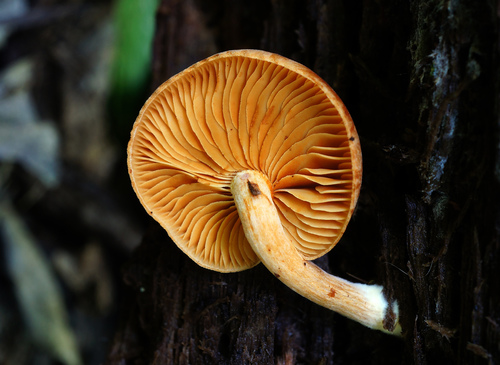
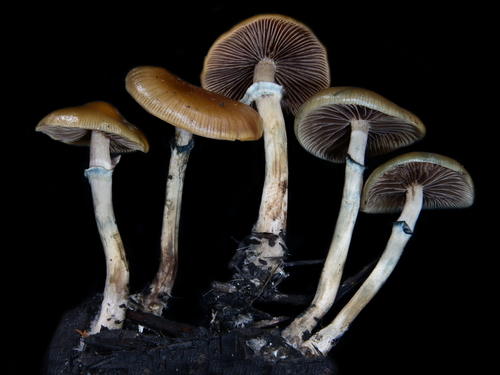
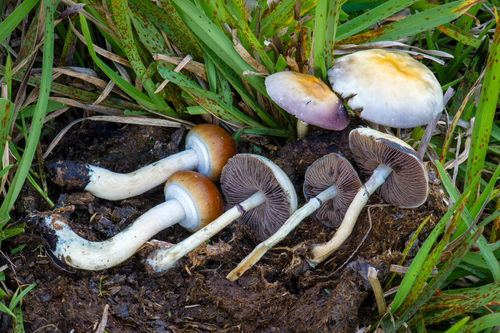
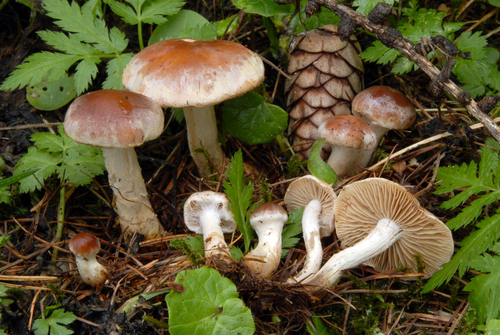
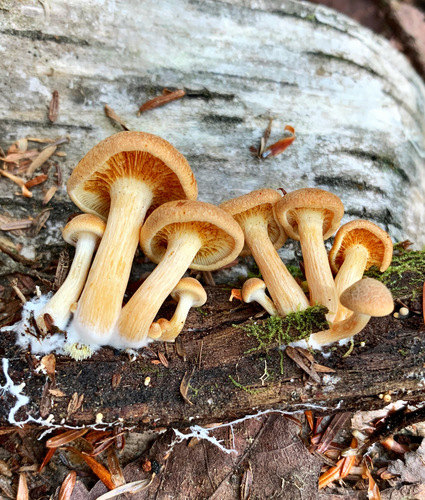
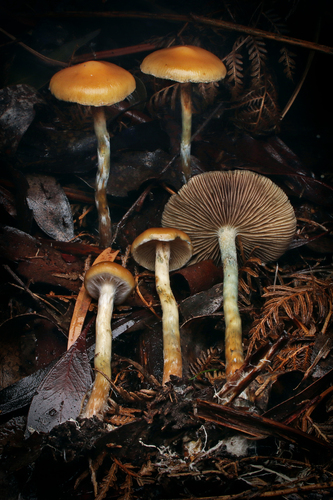
Psilocybe subaeruginosa Cleland has a cap that averages 12–50 mm in diameter. When young, the cap is conical to conic-convex with slightly inrolled edges; as it matures, it becomes convex, often slightly upturned, sub-gibbous, or sometimes develops a small acute umbo. The cap surface is slightly tacky, and young specimens may have veil remnants along the margin. Its color ranges from yellow-brown to orange-brown, paler toward the margin, which is slightly striate. The cap is hygrophanous, fading to pallid biscuit brown or pale orange-yellow when it dries. Both the cap and its whitish internal flesh stain greenish blue when handled or with age. The gills are moderately spaced, pale smoky brown when young, becoming violet-brown or brownish fuscous with age. They have narrow pale edges, are slightly ventricose, and arranged in three series, with the middle series extending halfway to the stipe. Gills attach to the stipe via an adnate or broadly adnexed connection, and sometimes lines run down the stipe from the gills. The stipe measures 25–70 × 2–3.5(-5) mm; it is tall and slender, equal in width or slightly wider toward the cap, with fine vertical lines. The stipe top is mealy, with fine fibrils below the top. The base is somewhat swollen, or can develop into a mass of mycelium. The stipe is hollow internally, cartilaginous in texture, pale whitish streaked with dark greyish brown, and stains greenish blue; its internal flesh is brownish. A white cortinate partial veil disappears quickly, leaving only traces as a raised ring around the upper part of the stipe. The taste and odour are farinaceous, and the spore print is purple brown. Cheilocystidia measure 17–29 × 5.5–11 μm, are hyaline, and shaped fusoid-ventricose, subpyriform, or mucronate, often with an elongated neck 2–4.5 μm wide at the apex. Pleurocystidia measure 22–47 × 6–16 μm, are hyaline, and share the same shape as cheilocystidia. Spores are smooth, subellipsoid, have an apical germ pore, and measure (10) 13.2–14.3 (15.4) × 6.6–7.7 × 6–7.5 μm. In terms of distribution and habitat, Psilocybe subaeruginosa grows from solitary to gregarious on wood debris in Australian native forests and pine plantations, and is occasionally found growing on dung. It is common in southern parts of Australia from April to August. It also occurs in Australian native and Eucalyptus forests, and is famously found growing on wood chip in New Zealand, where it is recorded as present. DNA sequencing of collections from New Zealand indicates that P. allenii and P. cyanescens also occur there alongside P. subaeruginosa.