About Psilocybe serbica M.M.Moser & E.Horak
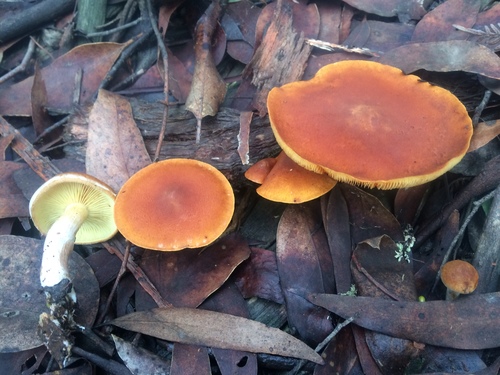
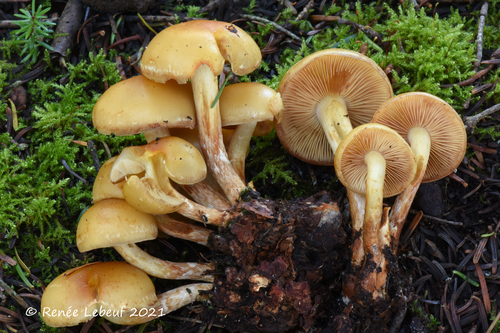
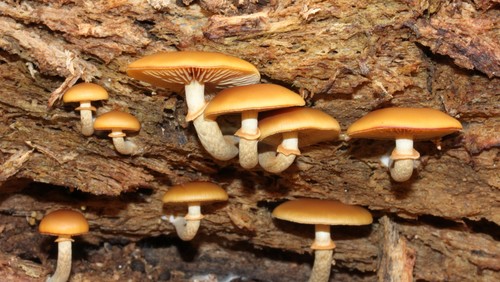
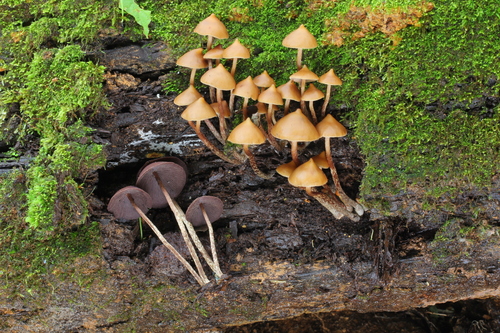
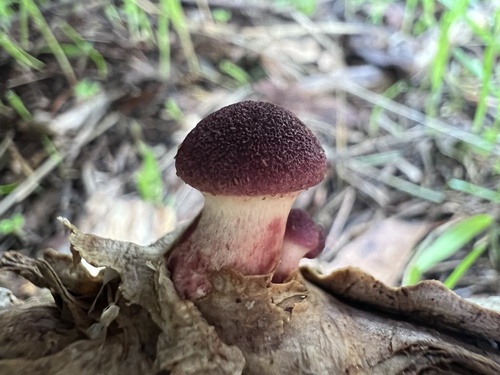
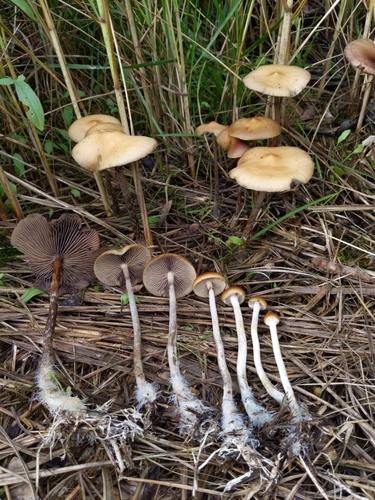
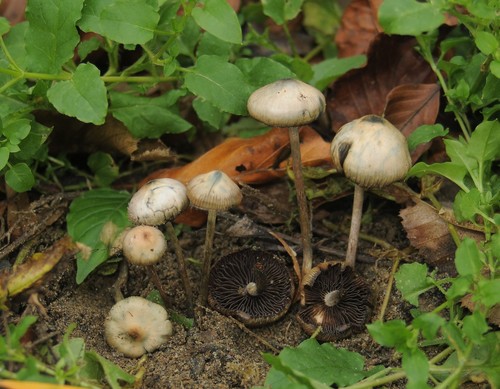
Psilocybe serbica is a highly variable mushroom species. It does not have a distinct smell; it can carry a slight radish-like odor, but is never farinaceous, and it typically tastes bitter. The cap measures 1–4 cm (0.4–1.6 in) in diameter. It starts out obtusely conical, and becomes campanulate or convex as it develops, expanding to broadly convex or flat when mature. The cap margin is initially incurved, becoming flat or decurved with age. The cap color ranges from buff-brown to dingy orangish-brown, and fades to pale ochraceous when dry. The cap surface is smooth and hygrophanous, and is slightly translucent-striate when moist. It is not viscid, and does not have a separable gelatinous pellicle. The flesh is whitish to cream-colored, and bruises blue when injured. Spores are purple-brown, ellipsoid, slightly flattened, thick-walled, and have a distinct germ pore. Spore size is very variable; most spores measure 10–13 × 6–7.5 μm, but some spores grow much longer. The gills are adnate to adnexed, closely spaced, and often distinctly subdecurrent. They start light brown, darkening to dark brown with a purple tint as the mushroom matures, while the gill edges remain paler. The stipe is 45–80 mm (1.8–3.1 in) long and 2–10 mm (0.1–0.4 in) thick. It is generally equal in width, and slightly widens at the base. It is whitish, has a silky gloss, and is either glabrous, or bears some whitish remnants of the fibrillose veil. Pleurocystidia are present and frequent, while cheilocystidia often grow from hyphae that run parallel to the lamella edge. This species grows mostly in groups, on well-decayed deciduous and coniferous wood. It also grows along Urtica species or Rubus species, on twigs, compost, and plant residue in forest habitats. It usually occurs in moist locations along creeks, forest paths, and roadside verges. Unlike Psilocybe cyanescens, it is not reported to be synanthropic, though it may very rarely grow on woodchips.