About Psilocybe semilanceata (Fr.) P.Kumm.
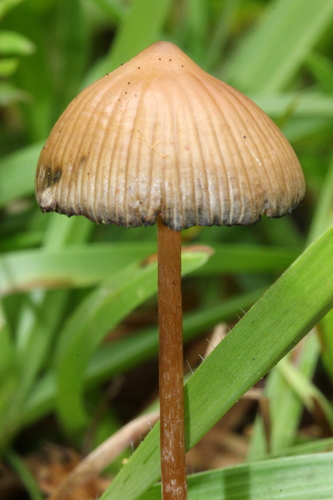
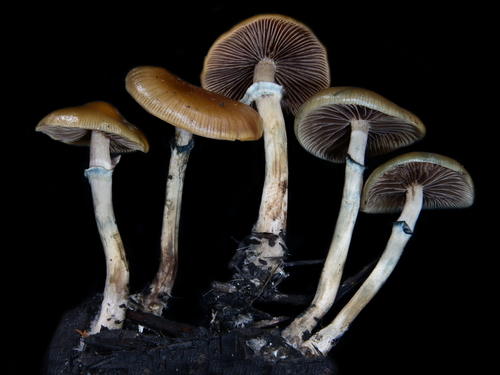
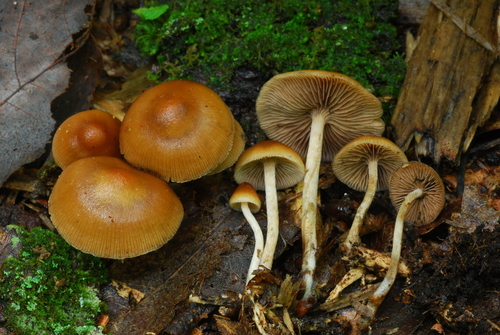
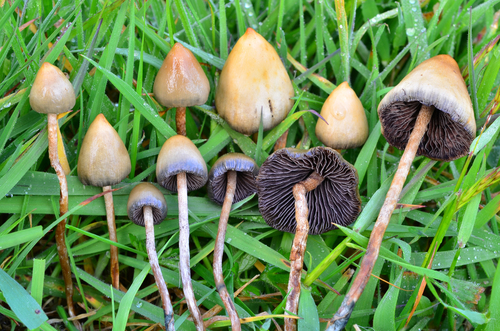
Psilocybe semilanceata (Fr.) P.Kumm. has a cap that ranges from 5–25 mm (0.20–0.98 in) in diameter and 6–22 mm (0.24–0.87 in) tall. Cap shape varies from sharply conical to bell-shaped, often with a prominent nipple-shaped structure called a papilla, and does not change shape significantly as it ages. The cap margin is initially rolled inward, but unrolls to become straight or even curl upward as the mushroom reaches maturity. The cap is hygrophanous, which means its color changes depending on how hydrated it is. When moist, the cap is colored ochraceous to pale brown to dark chestnut brown, darker at the center, and often has a faint greenish-blue tinge. Radial grooves called striations matching the position of the underlying gills are visible on moist caps. When the cap dries out, it becomes much paler, turning a light yellow-brown. Moist caps have a sticky surface caused by a thin gelatinous film called a pellicle; this film can be seen if you bend the cap to break it and peel away a piece of cap tissue. When the cap dries after sun exposure, the pellicle turns whitish and can no longer be peeled. On the underside of the cap, there are 15 to 27 narrow, moderately crowded gills that attach to the stipe in a narrowly adnexed to almost free arrangement. Gills start pale brown, and darken to dark gray to purple-brown with a lighter edge as spores mature. The stipe is slender, yellowish-brown, 4.5–14 cm (1.8–5.5 in) long by 1–3.5 mm (0.04–0.14 in) thick, and usually becomes slightly thicker toward its base. This species has a thin cobweb-like partial veil that disappears quickly after it matures; sometimes the veil leaves an annular (ring-shaped) zone on the stipe that may be darkened by deposited spores. The mushroom's flesh is thin and membrane-like, and roughly matches the color of the mushroom's outer surface tissue. It has a farinaceous odor and taste, similar to freshly ground flour. All parts of Psilocybe semilanceata stain bluish when handled or bruised, and may naturally turn blue with age. Microscopically, spores are deep reddish purple-brown in spore deposit. Under an optical microscope, spores appear oblong in side view, and oblong to oval in frontal view, with dimensions of 10.5–15 by 6.5–8.5 μm. The spore-bearing basidia of the hymenium measure 20–31 by 5–9 μm, are four-spored, have clamps at their bases, and no basidia grow on the sterile gill edge. Cheilocystidia (cystidia located on the gill edge) measure 15–30 by 4–7 μm, are flask-shaped with long thin necks 1–3.5 μm wide. Psilocybe semilanceata does not produce pleurocystidia (cystidia on the gill face). The cap cuticle is up to 90 μm thick, and forms an ixocutis: a gelatinized layer of hyphae that lie parallel to the cap surface. The hyphae that make up the ixocutis are cylindrical, hyaline, and 1–3.5 μm wide. Directly below the cap cuticle is the subpellis, made of hyphae 4–12 μm wide with yellowish-brown encrusted walls. Clamp connections are present in the hyphae of all mushroom tissues. Ecologically, Psilocybe semilanceata fruits either alone or in groups on rich acidic soil, most commonly in grasslands including meadows, pastures, and lawns. It is often found in pastures fertilized with sheep or cow dung, though it does not typically grow directly on the dung itself. Like all species in the genus Psilocybe, it is a saprobic fungus that gets nutrients by breaking down organic matter. It is also associated with sedges growing in moist field areas, and is thought to live on decaying root remains. At least one study has documented an association between P. semilanceata and the roots of the grasses Agrosiis tenuis, Poa annua, and the dicot Lolium perenne. Like some other grassland psilocybin mushroom species including P. mexicana, P. tampanensis, and Conocybe cyanopus, P. semilanceata may form sclerotia: a dormant fungal form that provides protection from wildfires and other natural disasters. Laboratory tests have shown P. semilanceata suppresses growth of Phytophthora cinnamomi, a soil-borne water mold that is a virulent plant pathogen causing root rot. When grown in dual culture with other saprobic fungi isolated from the rhizosphere of grasses in its natural habitat, P. semilanceata significantly suppresses their growth. This antifungal activity, which comes at least partly from two phenolic compounds the species secretes, helps it compete successfully for nutrients from decaying plant matter against other fungal species. Standard antimicrobial susceptibility testing has shown Psilocybe semilanceata strongly inhibits growth of the human pathogen methicillin-resistant Staphylococcus aureus (MRSA); the source of this antimicrobial activity is not known. Psilocybe authority Gastón Guzmán, in his 1983 monograph on psilocybin mushrooms, classified Psilocybe semilanceata as the world's most widespread psilocybin mushroom species, with confirmed reports from 18 countries. It has a widespread distribution across Europe, where it has been recorded in Austria, Belarus, Belgium, Bulgaria, the Channel Islands, Czech Republic, Denmark, Estonia, the Faroe Islands, Finland, France, Georgia, Germany, Greece, Hungary, Iceland, India, Ireland, Italy, Latvia, Lithuania, the Netherlands, Norway, Poland, Romania, Russia, Slovakia, Slovenia, Spain, Sweden, Switzerland, Turkey, the United Kingdom, and Ukraine. It is generally accepted that the species is native to Europe; research by Watling found little morphological or genetic difference between specimens collected from Spain and Scotland. It is also widespread across North America. In Canada, it has been collected from British Columbia, New Brunswick, Newfoundland, Nova Scotia, Prince Edward Island, Ontario, and Quebec. In the United States, it is most common in the Pacific Northwest west of the Cascade Mountains, where it fruits abundantly in autumn and early winter; infrequent fruiting has also been reported during spring. Charles Horton Peck reported the mushroom from New York in the early 20th century, which led most subsequent literature to list the species as present in the eastern United States. When Guzmán later examined Peck's herbarium specimen for his 1983 comprehensive monograph on Psilocybe, he concluded Peck had misidentified what is now known as Panaeolina foenisecii as P. semilanceata. P. semilanceata is much less common in South America, where it has only been recorded in Chile. It is also found in Australia, where it may be an introduced species, and in New Zealand, where it grows in high-altitude grasslands. It was reported from Golaghat, in the Indian state of Assam in 2000, and from Charsadda, in the Pakistani province of Khyber Pakhtunkhwa in 2017. The first reliably documented report of intoxication from Psilocybe semilanceata comes from a British family in 1799, who prepared a meal with mushrooms they picked in London's Green Park. According to chemist Augustus Everard Brande, the father and his four children developed typical symptoms after ingestion including pupil dilation, spontaneous laughter, and delirium. The species responsible was confirmed via James Sowerby's 1803 book Coloured Figures of English Fungi or Mushrooms, which included a description of the fungus, then known as Agaricus glutinosus originally described by Moses Ashley Curtis in 1780. German mycologist Jochen Gartz notes the species description is fully compatible with current understanding of Psilocybe semilanceata. In the early 1960s, Swiss scientist Albert Hofmann—best known for synthesizing the psychedelic drug LSD—chemically analyzed P. semilanceata fruit bodies collected in Switzerland and France by botanist Roger Heim. Using paper chromatography, Hofmann confirmed dried samples contained 0.25% psilocybin by weight. Their 1963 publication was the first report of psilocybin found in a European mushroom species; before this, psilocybin was only known from Psilocybe species native to Mexico, Asia, and North America. This finding was later confirmed in the late 1960s with specimens from Scotland and England, then from Czechoslovakia in 1973, Germany in 1977, Norway in 1978, and Belgium and Finland in 1984. In 1965, forensic analysis of psilocybin-containing mushrooms seized from college students in British Columbia identified the species as P. semilanceata, marking the first recorded case of intentional recreational use of the mushroom in Canada. The presence of the psilocybin analog baeocystin was confirmed in 1977. Multiple studies published since have found that psilocybin content in P. semilanceata varies very little regardless of the country the mushrooms are collected from.