About Psilocybe pelliculosa (A.H.Sm.) Singer & A.H.Sm.
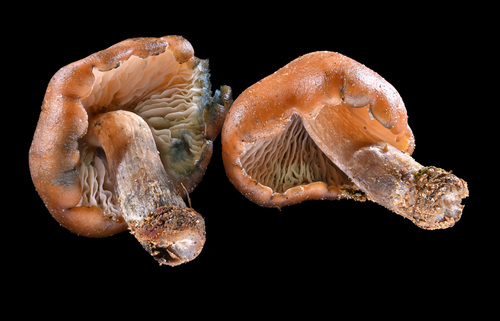
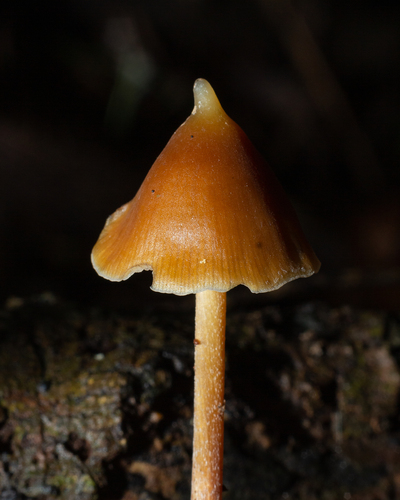
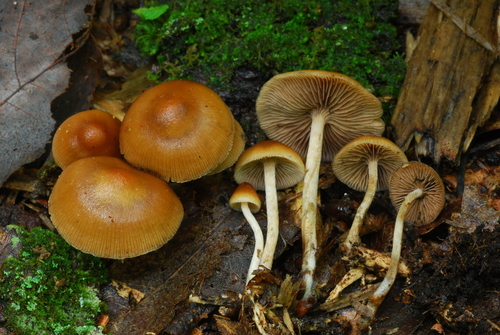
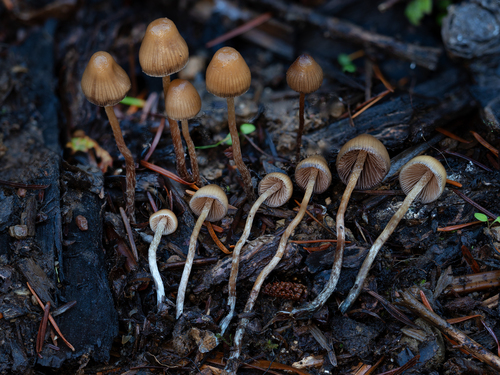
Psilocybe pelliculosa (A.H.Sm.) Singer & A.H.Sm. has an initially sharply cone-shaped cap that expands slightly over time into a broadly bell shape, and never becomes fully flat. The cap margin is pressed against the stem initially, and remains appendiculate (with partial veil fragments hanging from the margin) for a short time. Mature caps are smooth, sticky, and have translucent radial striations, reaching 0.8 to 2 cm (3⁄8 to 3⁄4 in) in diameter. When moist, the cap color ranges from umber to isabella, a dark dingy yellow-brown, and changes to pinkish-buff when dry; the cap margin may have a greenish-gray tinge. The cap cuticle is a thin gelatinous covering that can be peeled off. The gills have an adnate attachment to the cap, are narrow to moderately broad and closely spaced, and eventually separate from the stem. Young gills are cinnamon-brown with lighter edges, and darken as they mature when covered by dark spores. The stem is 6 to 8 cm (2+3⁄8 to 3+1⁄8 in) long by 1.5 to 2 mm (1⁄16 to 3⁄32 in) thick, roughly equal in width along its length with only a slightly enlarged base, and is rather pliant but rigid. The lower section of the stem is brownish with silky fibrils pressed against its surface; the upper stem is grayish and pruinose, lightly dusted with powdery white granules. The flesh turns slightly bluish or greenish when injured. A drop of dilute potassium hydroxide solution on the cap or flesh causes a color change to pale to dark yellowish to reddish brown, while a drop on the stem produces a less intense color change or no color change at all. The spore print is purplish brown, and spores appear dull purple-brown under the microscope. They are ellipsoid to somewhat egg-shaped: Singer's original description recorded a size of 8–10 by 4–5 μm, while a later study of specimens collected from British Columbia, Canada, reported a larger size range of 10–13 by 6–7 μm. Spores have an apical germ pore. The spore-bearing basidia are four-spored, hyaline (translucent), and measure 22–35 by 7–10 μm. Abundant cystidia form a sterile band on the gill edges (cheilocystidia); these cystidia are smooth, inflated, and fusoid-ventricose (enlarged in the middle and tapered toward both ends) with a sharp tip, and measure 25–30 by 6–9 μm. The cap cuticle is an ixocutis made of a layer of roughly horizontal, gelatinized, wavy, hyaline hyphae 0.8–5.5 μm in diameter. Fruit bodies of P. pelliculosa grow in groups or clusters on moss, forest debris, and humus in coniferous forests. The fungus prefers to fruit in disturbed areas such as trails and abandoned forest roads, and is not commonly found in grasslands. It is known from the Pacific Northwest region of North America, where it has been collected in California, Idaho, Oregon, Washington, and is widely distributed in British Columbia, Canada. It is also found in northern Europe, with a single collection recorded from Finland. The fungus often fruits along forest paths and abandoned logging roads where alders and firs grow. Fruit bodies tend to appear in late summer to early winter after cool, wet weather.