About Psilocybe ovoideocystidiata Guzmán & Gaines
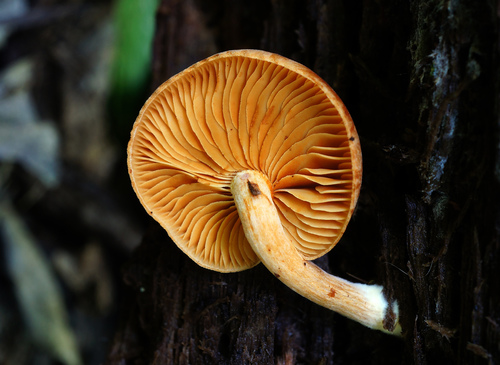
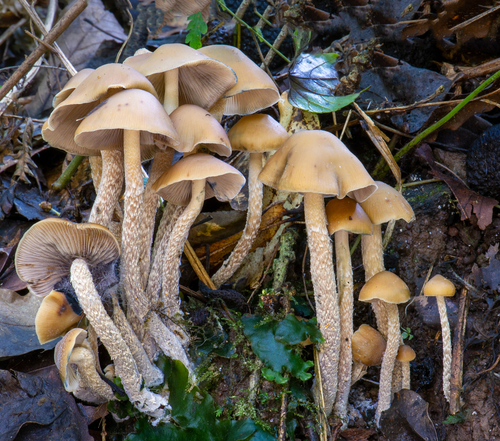
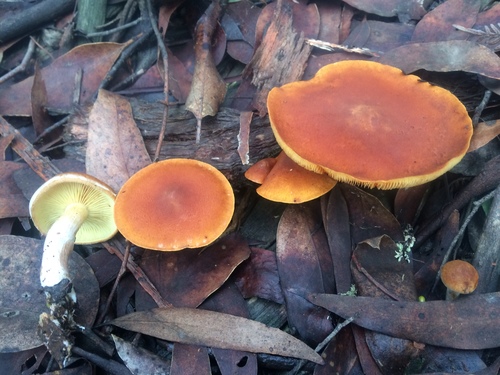
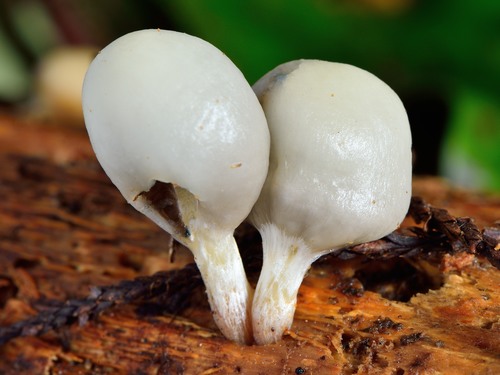
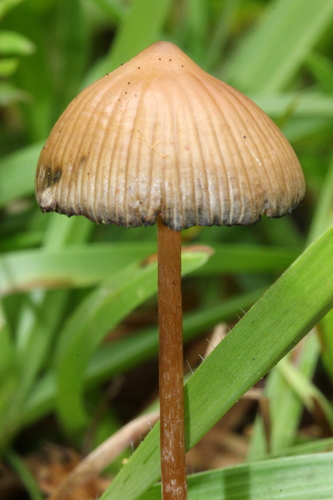
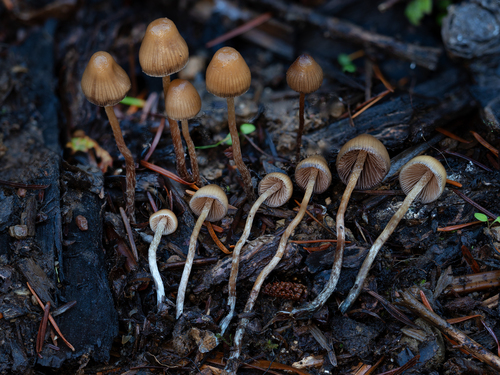
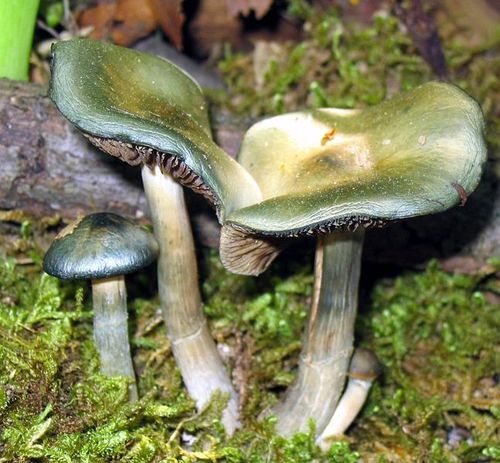
Psilocybe ovoideocystidiata Guzmán & Gaines has a cap that measures (1) 1.5 to 5 (8) cm across. Caps are convex to subumbonate, and range in color from chestnut or orangish brown to yellowish brown to pearly cream. The cap is hygrophanous, glabrous, sub-viscid, and has translucent striations near its margin; mature caps are slightly to highly undulated. Young specimens usually have a strongly convex, dark brown to black cap paired with a white stem. When the mushroom reaches maturity, its entire body becomes light brown, and it is cinnamon-brown when moist and light beige when dry. Mature specimens often naturally show blue-green bruising, while old, dried-out specimens are usually entirely black. Individual appearance can vary considerably based on maturity and growing location. The flesh is thick and pliant, and bruises blue and green when injured. Gills have an adnate attachment, and range in color from whitish to rusty brown, lavender, or dark purple brown. The spore print is dark purple brown. The stipe measures (1.5) 3 to 9 (13) cm long by (2) 3 to 15 (20) mm wide. It is equal in width along most of its length, somewhat subbulbous, and hollow. The base is sometimes hypogeous; the top section is smooth, and the lower section often has small hairs. The stipe is whitish with irregular yellowish, brownish, or bluish tones. The partial veil is variable: it can range from a thin cortina that leaves only a barely visible annular zone, to a substantial membrane that leaves a fairly persistent annulus. When a veil remnant is present, it is most often found near the middle of the stem, unlike many other Psilocybe species, which have veil remnants just under the cap. The taste is farinaceous, and the odor is farinaceous to spicy. Microscopically, spores measure (7–) 8–9 (–12) × (5.5–) 6–7 (–8.5) μm. They are rhomboid to subrhomboid when viewed from the face, and subellipsoid when viewed from the side, with thick walls 0.8 to 1.5 μm thick. One end of the spore has a broad germ pore, and the opposite side has a short hilar appendage. Two types of cheilocystidia and pleurocystidia are present. One type of pleurocystidia measures 16-24 × 6-8 μm and is ventricose-rostrate. The other type is larger, measuring 20-40 × 12-16 μm, and is globose-pyriform, sometimes with a narrow apex and narrow base. The basidia are 4-spored and measure 20–28 × 7–9 μm. Psilocybe ovoideocystidiata is primarily native to the Eastern United States, where its range extends from Missouri east to Rhode Island, and from Georgia north to Michigan. It is especially common in the Ohio River valley. It also grows in Western North America, from Southern California north to British Columbia, Canada. As a relatively recently described species, it is frequently reported from new locations, leading to speculation that its range is currently expanding. This species grows on woody debris, and can be found along rivers and streams, most often in flood overflow areas, as well as in human-placed mulch and wood chips in urban and suburban environments. It is sometimes found growing alongside Japanese knotweed, and tends to prefer shaded areas, avoiding direct sunlight. It is typically gregarious: it may grow in groups of hundreds of individuals in a single area, or form multiple small clusters of several mushrooms each that are close to one another. Solitary specimens may also occur occasionally. Fruiting season varies widely by region. In the northeastern US, it is most common in spring, from mid-April to late June, peaking in late May. It fruits especially after several consecutive days of steady heavy rain, a common spring weather pattern in the eastern US. Occasional fruiting may occur as late as November, however. The mushrooms are very sensitive to season, and fruit primarily in spring, with very little fruiting at other times of year even when weather conditions are favorable.