About Psilocybe neoxalapensis Guzmán, Ram.-Guill. & Halling
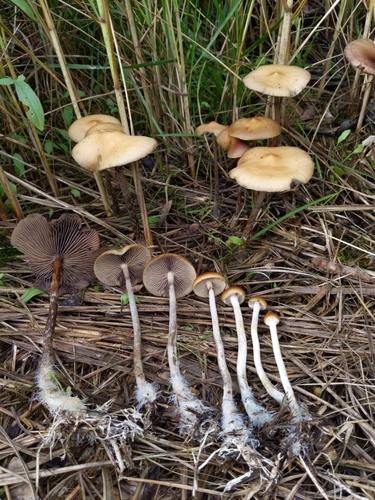
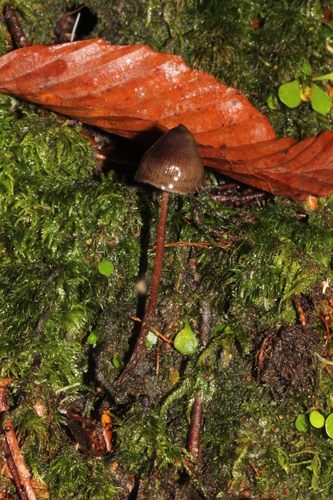
Psilocybe neoxalapensis has a cap measuring 8–30 mm (0.3–1.2 in) in diameter. Its shape ranges from conical to bell-shaped (campanulate), and it often has a prominent nipple-shaped structure called a papilla. The cap does not change much in shape as it matures. The cap is hygrophanous, meaning it displays different colors depending on how hydrated it is. When moist, the cap is dark reddish brown to chocolate brown, sometimes this color is concentrated in the center, and occasionally it has a greenish-blue tinge. When moist, radial lines matching the position of the gills underneath the cap can be seen through the cap tissue. When the cap dries out, it becomes much paler, ranging from light yellow-brown to olivaceous brown. Under the cap, the gills are narrow and moderately crowded. They attach to the stipe in an adnexed to sinuate pattern. They start out cream colored, and darken to dark purple-brown with a lighter edge as spores mature. The spore print of this species is a deep reddish purple-brown. The slender stipe is 30–50 mm (1–2 in) long and 1–2 mm thick, and it is usually slightly thicker toward its base. Its color is paler near the apex, and the lower half is covered in small, floccose whitish fibrils. The base of the stipe has a long whitish pseudorhiza that can reach up to 150 mm. The flesh is thin and membrane-like, ranging from white to brownish. This mushroom has a thin, cobweb-like partial veil that does not persist long before disappearing; sometimes it leaves an annular (ring-shaped) zone on the stipe that may be darkened by spores. Its taste and odor are farinaceous, with a slight similarity to oil paint. All parts of the mushroom can stain bluish when handled or bruised, but the mushroom’s abundant natural reddish to brown pigment makes the blue staining difficult to see. In spore deposits, spores are deep reddish purple-brown. When viewed under an optical microscope, spores are subellipsoid in side view and rhomboid in frontal view, with dimensions of (3.5–) 5–6 (–7) by 6.5–8.5 μm. The basidia, the spore-bearing cells of the hymenium, measure 14–25 by 4.5–7.5 μm and are four-spored. Cheilocystidia (cystidia growing on the gill edge) occur in two forms. Type A is narrowly lageniform, measures 15–27 by 5–7 μm, and is often branched at the apex. Type B is subventricose-subcylindrical or narrowly utriform, and measures 25–32 by 6–9 μm.