About Psilocybe mexicana R.Heim
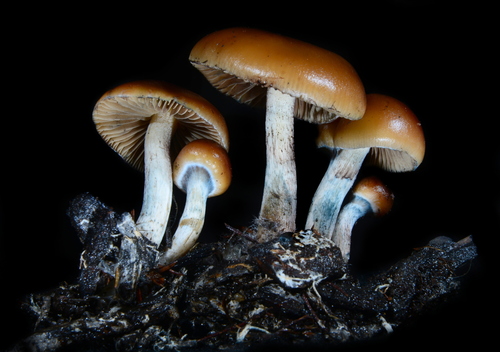
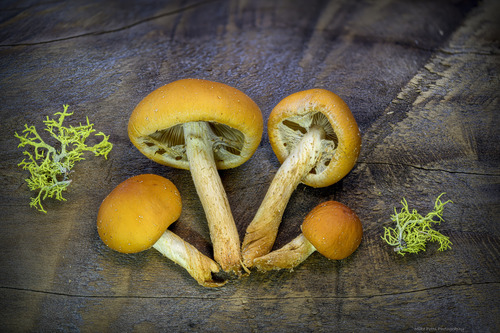
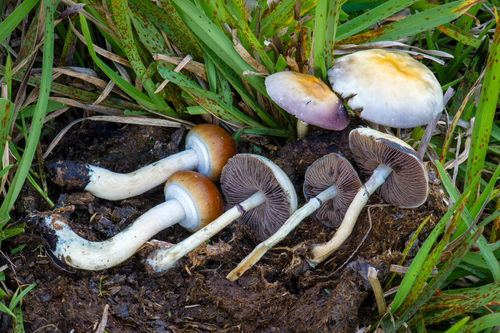
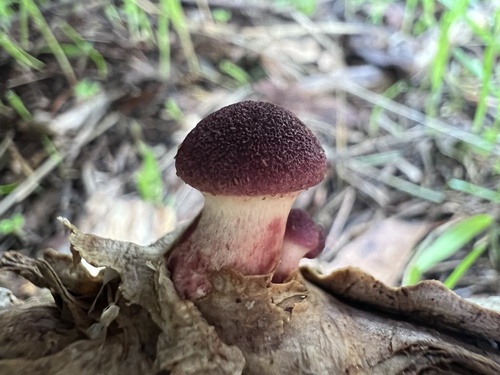
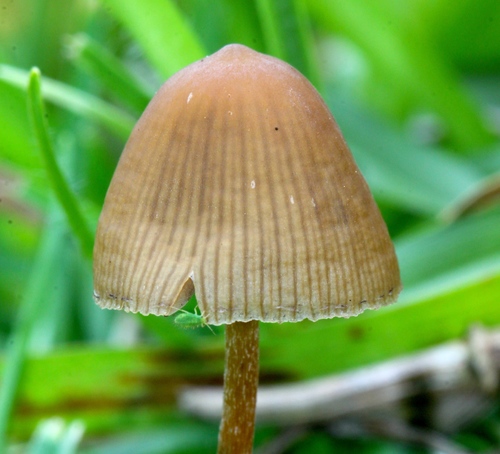
Psilocybe mexicana R.Heim is a species of psilocybin mushroom with the following morphological features. Its cap measures (0.5)1 to 2(3) cm in diameter, with a shape ranging from conic to campanulate or subumbonate, and often bears a slight papilla. The cap is hygrophanous or glabrescent, with a margin that is even to striate, and its color ranges from ocherous to brown or beige to straw when mature, sometimes taking on blueish or greenish tones, and it easily turns blue when injured. Its gills are either adnate or adnexed, and are gray to purple-brown with whitish edges. The spore print of this species is dark purple-brown. The stipe grows 4 to 10(12.5) cm tall by 1 to 2(3) mm thick, is equal in width along its length, hollow, and colored straw to brownish or reddish-brown, darkening in areas where it is injured, and has no annulus. Both the odor and taste of Psilocybe mexicana are farinaceous. Microscopically, its spores are 8 to 12 μm by 5 to 8 μm, ovoid in shape and smooth. Its cheilocystidia measure 13–34 μm, are fusoid-ampullaceous to sublageniform, and sometimes have a forked neck. Its pleurocystidia are either sublageniform or absent entirely. Psilocybe mexicana may form sclerotia, a dormant form of the organism that provides it with some protection from wildfires and other natural disasters. In terms of distribution and habitat, Psilocybe mexicana grows alone or in small groups among moss along roadsides and trails, in humid meadows or cornfields, particularly in grassy areas bordering deciduous forests. It is common at elevations between 300–550 metres (980–1,800 ft), rare at lower elevations, and is only known to occur in Mexico, Costa Rica, El Salvador and Guatemala. Fruiting occurs from May to October. For consumption and cultivation, like many other psilocybin mushrooms in the genus Psilocybe, Psilocybe mexicana has been consumed by indigenous North American peoples for its entheogenic effects. In the Western world, sclerotia of Psilocybe mexicana are sometimes cultivated for entheogenic use, and the sclerotia have a lower content of active substances than the actual fruiting bodies of the mushroom.