About Psilocybe hoogshagenii R.Heim
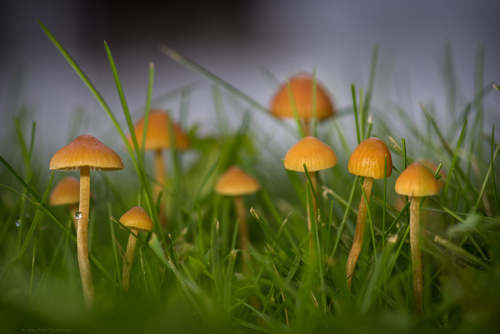
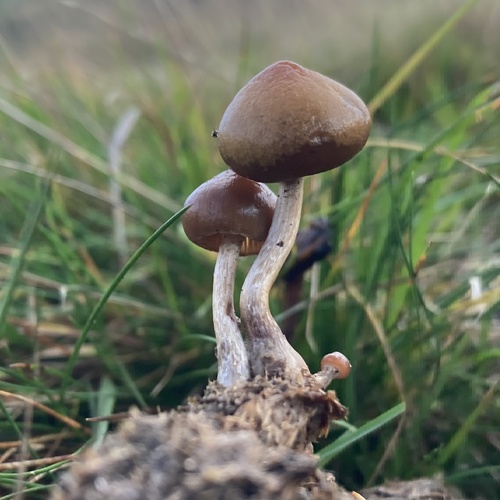
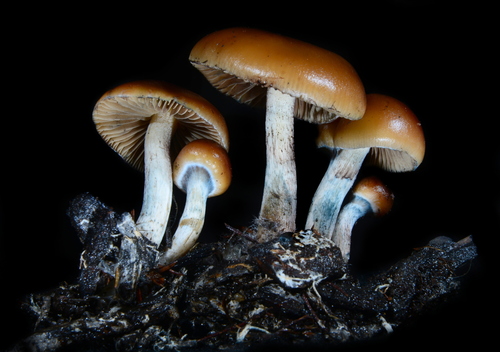
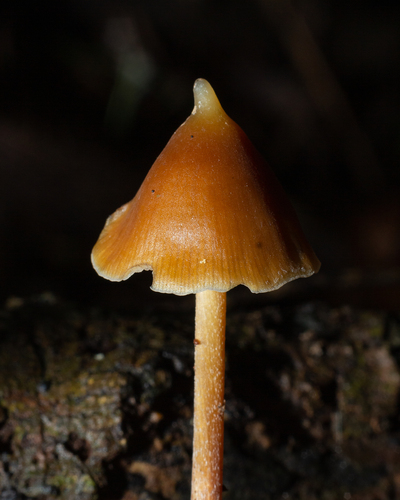
Psilocybe hoogshagenii R.Heim has a cap that ranges in shape from conical to bell-shaped to convex, with a diameter between 18 and 76 mm (0.7–3 in), though the most common diameter range is 1–2.5 cm (0.4–1.0 in). The cap has a long, sharp papilla that can reach up to 4 mm (0.16 in) in length. The cap surface is smooth, somewhat sticky when wet, and often has ridges that extend halfway to the cap's center. Its color ranges from reddish brown to orangish brown to yellowish, and it is hygrophanous, fading to a straw or fulvous color when it dries. The brownish gills attach to the stem in an adnate to adnexed pattern; mature gills turn purplish black due to the presence of spores. The hollow stem is 50 to 90 mm (2.0 to 3.5 in) long and 1–3 mm thick. It is roughly the same width along its entire length, or slightly thicker at the base, and may sometimes be twisted. Immature fruit bodies have a thin, rudimentary cortina-like partial veil that covers the gills, but this veil is fragile and disappears quickly after the cap expands. The flesh of the cap is whitish, while the stem's flesh is more yellow. Both the odor and taste of the mushroom are farinaceous, meaning they resemble freshly ground flour. As is characteristic of psilocybin mushrooms, all parts of the fruit body bruise blue when handled or injured. P. hoogshagenii var. convexa does not have an acute papilla, though it may occasionally develop a small, rounded papilla. Its cap is 0.5–1.5 cm (0.20–0.59 in) wide, and has a convex to roughly bell shape. All other macroscopic and microscopic features of this variety are identical to the type variety. The spore print of Psilocybe hoogshagenii is dark purplish brown. Spores appear rhomboid or nearly rhomboid when viewed from the face, and roughly ellipsoid when viewed from the side. They have thick walls, measure 6.5–4–5.6 μm, and have a broad germ pore. The spore-bearing basidia are usually four-spored, hyaline (translucent), roughly cylindrical or have a central constriction, and measure 12–22 by 5.5–9 μm. Pleurocystidia (cystidia on the gill face) are relatively abundant; they are ventricose (swollen), club-shaped or irregularly shaped, and measure 16–36 by 8–12 μm. Cheilocystidia (cystidia on the gill edge) are also abundant. They measure 19–35 by 4.4–6.6 μm, are lageniform (flask-shaped), narrowing into a long neck 1–3 μm wide, and end in either an acute or somewhat capitate (roughly globular) tip. Clamp connections are present in the hyphae. Fruit bodies of Psilocybe hoogshagenii grow solitarily or in small groups in humus or muddy clay soils in subtropical coffee plantations. According to natives of the San Agustin Loxicha region of Mexico, this fungus tends to fruit simultaneously in large flushes. In Mexico, fruiting occurs in June and July, while in Argentina, fruiting occurs in February. The species has been reported from Mexico in the states of Puebla, Oaxaca, and Chiapas, where it grows at elevations of 1,000 to 1,800 m (3,300 to 5,900 ft). In South America, it is known from Brazil and Colombia. P. hoogshagenii var. convexa has been found in grasslands in Hidalgo and Oaxaca, and is most common in Puebla, where it fruits from June to August. Psilocybe hoogshagenii mushrooms are used for entheogenic, or spiritual, purposes by some Chinantec-speaking curanderos of the Ixtlán District in Oaxaca. They are primarily used to diagnose and prognose illness, and to a lesser extent to divine the location of lost or stolen objects or animals. Guzmán also notes that there is contemporary ceremonial use of the mushroom by Mixe and Zapotec people. In his book Psilocybe Mushrooms of the World, Paul Stamets rates the psychoactive potency of this mushroom as "moderately active", and reports psilocybin levels of 0.6% (milligrams per gram of dried mushroom) and psilocin levels of 0.1%. For comparison, Stamets notes that the commonly cultivated species P. cubensis contains 0.63% psilocybin and 0.60% psilocin, while the widespread P. semilanceata contains 0.98% psilocybin and 0.02% psilocin. Chemical analysis of P. hoogshagenii specimens from Brazil found up to 0.3% psilocybin and 0.3% psilocin.