About Psilocybe cyanescens Wakef.
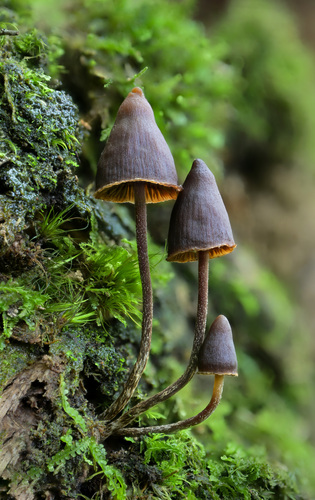
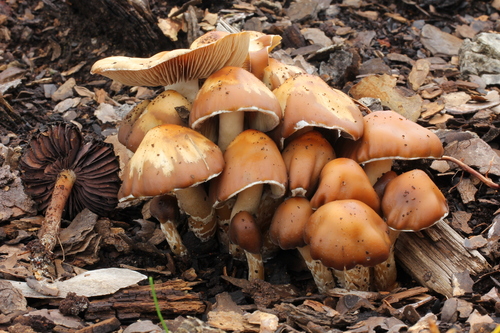
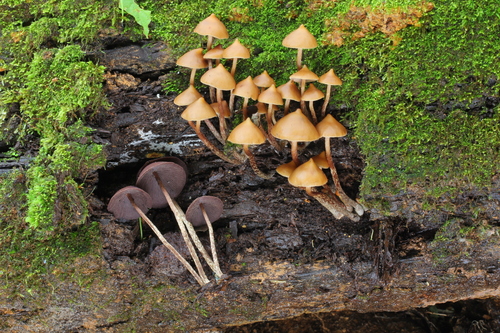
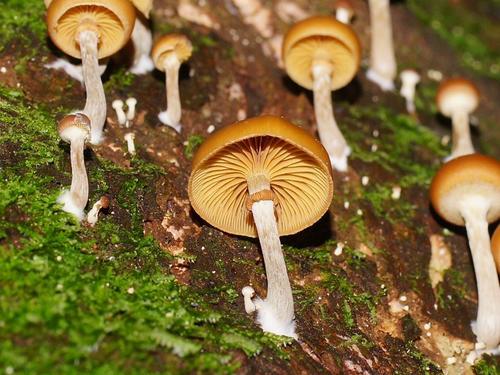
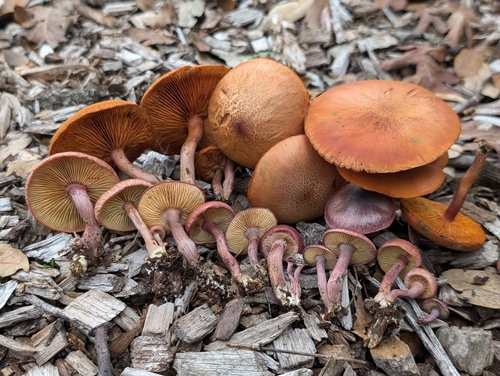
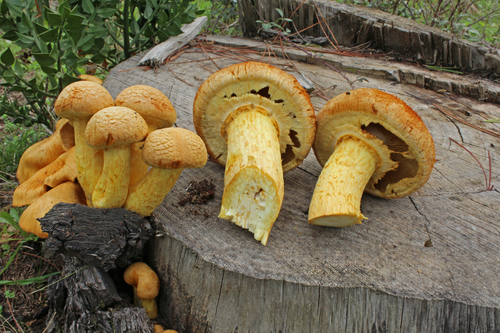
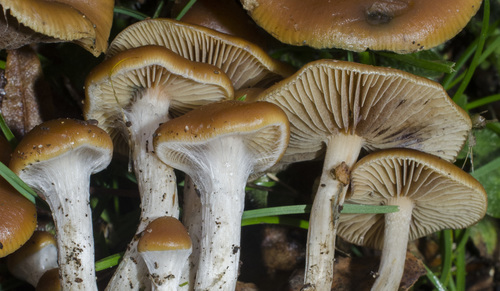
Psilocybe cyanescens Wakef. has a hygrophanous pileus (cap) that is caramel to chestnut-brown when moist, fading to pale buff or slightly yellowish when dried. Caps generally measure 1.5–5 cm (1⁄2–2 in) across, and are normally distinctly wavy when mature. This specific pileus color is rarely seen in mushrooms outside of the P. cyanescens species complex. Most parts of the mushroom, including the cap and lamellae (gills underneath the cap), can stain blue when touched or disturbed, most likely due to the oxidation of psilocin. The lamellae are adnate, and light brown to dark purple brown when mature, with lighter gill edges. There is no distinct annulus, but immature P. cyanescens specimens do have a cobwebby veil that may leave an annular zone when mature. Both the odor and taste are farinaceous. P. cyanescens produces elliptical spores that measure 9–12 x 5–8 μm. Some authors originally noted that the species' holotype collection from Kew Gardens had no pleurocystidia, while North American collections are characterized by common clavate-mucronate pleurocystidia. However, pleurocystidia are actually present in the holotype collection, but are not easy to observe because the hymenium is collapsed. In European collections of P. cyanescens, pleurocystidia are common and have the same shape as those found in the United States. In 2012, an epitype from Hamburg, Germany was designated. Fresh sporocarps and mycelia of P. cyanescens generally bruise blueish or blue-green where damaged, and the staining remains visible after drying. This staining is most noticeable on the stem, which is white when undisturbed, but can also occur on other parts of the mushroom, including the gills, cap, and mycelium. This staining is caused primarily by the oxidation of psilocin. Psilocybin cannot be oxidized directly, but is quickly converted via enzymatic action to psilocin at injury sites, which can then be oxidized. This means even specimens with little psilocin still generally stain blue. Psilocybe cyanescens currently grows primarily on wood chips, especially in and along the perimeter of mulched plant beds in urban areas, but can also grow on other lignin-rich substrates. It does not grow on substrates that are not lignin-rich, and does not typically grow on mulch made from bark. Fruitings have previously been reported in natural settings, although most of these appear to be migrations from mulched plant beds. In the United States, P. cyanescens occurs mainly in the Pacific Northwest, stretching south to the San Francisco Bay Area. It can also be found in New Zealand, Western Europe, Central Europe, and parts of west Asia (Iran). Its range is rapidly expanding, especially in non-native areas, as the use of mulch for weed control has become popular. This rapid range expansion may be partly because P. cyanescens mycelium has colonized the distribution network of woodchip suppliers, and is thus distributed on a large scale with commercial mulch. It has been documented to fruit in Spring on the East Coast of the United States. While it has been speculated that P. cyanescens' native habitat is the coniferous woodlands of the north-western United States or coastal dunes in the PNW, and the type specimen was described from mulch beds in Kew Gardens, the natural wild distribution of P. cyanescens remains unknown. Fruiting depends on a drop in temperature. In the San Francisco Bay Area, fruiting typically occurs between late October and February. In other areas, fruiting generally occurs in fall, when temperatures are between 10–18 °C (50–64 °F). Psilocybe cyanescens often fruits gregariously or in cespitose clusters, sometimes in very large numbers. 100,000 P. cyanescens fruits were once found growing on a racetrack in the south of England. Solitary fruits are sometimes also found. To get fruiting, growers simulate a fall environment at temperatures between 10–18 °C (50–64 °F). Like many other psilocybin-containing mushrooms, P. cyanescens is sometimes cultivated. Due to its specific fruiting requirements, it is challenging but possible to get this species to produce fruits indoors. Outdoor cultivation in an appropriate climate is relatively easy. Yield per pound of substrate is low compared to other psilocybin-containing mushrooms for both indoor and outdoor cultivation. The combination of poor yield and difficulty may explain why P. cyanescens is grown less frequently than some other psilocybin-containing mushrooms. Psilocybe cyanescens mycelium is easier to grow than fruiting bodies, can be grown indoors, and is robust enough to be transplanted to start new patches. Mycelium can also be propagated via stem butt transplantation. Many of the cultivation techniques used for other members of the genus Psilocybe can also be used to grow P. cyanescens. Cultivated P. cyanescens contain approximately the same concentration of psilocin and psilocybin as naturally occurring specimens.