About Psilocybe cubensis (Earle) Singer
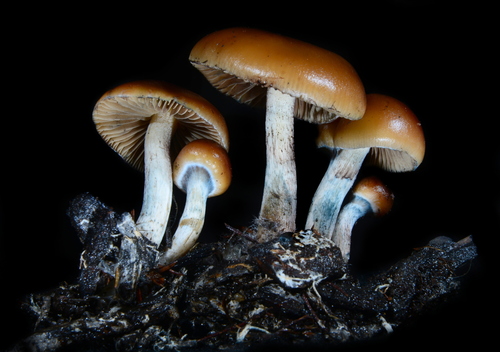
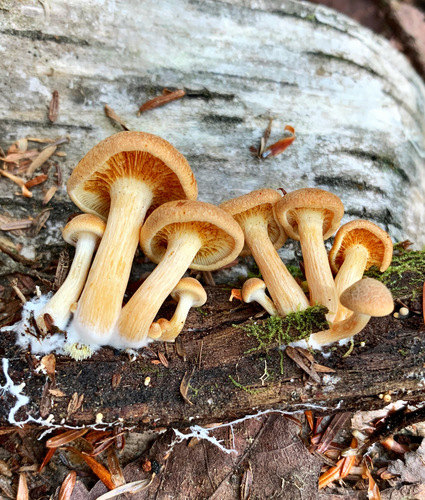
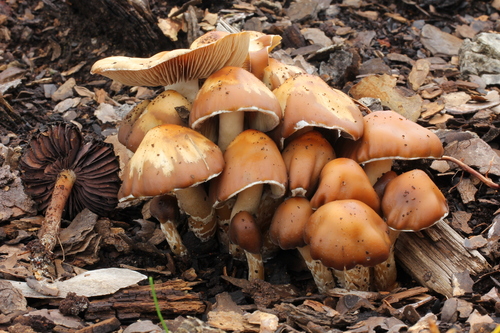
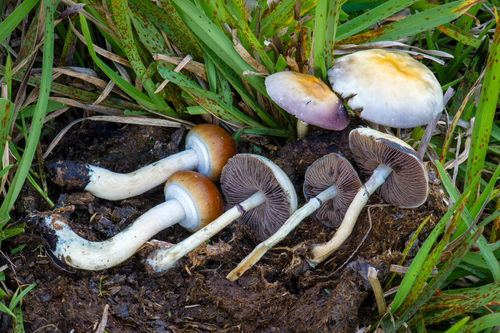
Psilocybe cubensis (Earle) Singer is a well-known psilocybin-containing mushroom species. The cap measures 1.6–8 cm across; it is conic to convex with a central papilla when young, and broadens to convex or plane with age, usually retaining a slight umbo that is sometimes surrounded by a ring-shaped depression. The cap surface is smooth and sticky, and sometimes has remnants of the white universal veil attached. Young caps are brown, paling to almost white at the margin, and fade to golden-brown or yellowish as they age. All parts of the mushroom stain blue when bruised. The narrow grey gills are adnate to adnexed, sometimes become seceded, and darken to purplish-black with a mottled appearance as they age; gill edges remain whitish. The hollow white stipe is 4–15 cm tall and 0.4–1.4 cm thick, and yellows with age. Its well-developed veil leaves a persistent white membranous ring, whose surface usually matches the gill color after collecting falling spores. Mature fruiting bodies are 90% water. The mushroom has no distinct odor, and is described as having a farinaceous taste, with an alkaline or metallic aftertaste. Spores measure 11.5–17.3 x 8–11.5 μm, and are sub-ellipsoid. Basidia are usually 4-spored, but may sometimes be 2- or 3-spored. Both pleurocystidia and cheilocystidia are present.
This is a pan-tropical species, with confirmed distribution across the Gulf Coast and southeastern United States, Mexico, the Central American countries of Belize, Costa Rica, Panamá, El Salvador, Guatemala; Caribbean countries including Cuba, the Dominican Republic, Puerto Rico, Guadalupe, Martinique, Trinidad; South American countries including Argentina, Bolivia, Brazil, Colombia, French Guiana, Paraguay, Uruguay, Peru; Southeast Asia including Thailand, Vietnam, Cambodia, Malaysia; plus India, Australia, and Fiji. It may also occur in Nepal and Hawaii. In 2018, the first confirmed collection of this species (and first reported psilocybin mushroom) in Zimbabwe was made in the Wedza District of Mashonaland East province, approximately 120 km southeast of Harare, at the Imire Rhino & Wildlife Conservation nature reserve that hosts both cattle and wildlife.
P. cubensis grows on cow dung, and occasionally horse dung; in Asia it also grows on water buffalo dung. It can also be found on sugar cane mulch or rich pasture soil. In the northern hemisphere, mushrooms appear from February to December, and from November to April in the southern hemisphere. It is thought to have been introduced to Australia alongside imported cattle, which had been brought to the Australian mainland from the Cape of Good Hope, Kolkata, and the American west coast, with 1800 cattle present by 1803. In Australia, it grows from northern Queensland to southern New South Wales.
Naturally, P. cubensis grows in tropical and subtropical conditions, most often near cattle, whose dung provides ideal growth conditions; spores consumed by cattle alongside grass or grains germinate within the dung. This species is relatively easy to cultivate indoors. For indoor cultivation, spores are first inoculated into sterilized carbohydrate-containing grain spawn (usually in jars or bags, most commonly rye grain). After around one month, spores fully colonize the grain to form dense mycelium, which is then planted into a bulk substrate such as a coconut husk fiber and vermiculite mixture. With proper humidity, temperature, and fresh air exchange, fruiting bodies grow within one month after planting. After harvesting, growers typically dehydrate fruiting bodies and store them in cool, air-tight containers to preserve potency.
A 2009 study found that P. cubensis grown in the dark contain higher levels of psilocybin and psilocin than those grown in bright indirect light, which have minimal levels of these compounds. Controlled studies using an environmentally controlled wind tunnel and computer modeling found that air humidity heavily impacts mushroom growth and transpiration: higher humidity accelerates transpiration, and produces faster overall growth, while light does not affect growth. Misting also increases both growth and transpiration rates during cultivation.
Small-scale cultivation, especially for beginners, often uses colonized 'cakes' grown in jars, which fruit in specialized tubs called shotgun fruiting chambers. The most common beginner-friendly method is PF-Tek (the Psilocybe Fanaticus technique), developed by the clandestine cultivator Psylocybe Fanaticus. Cakes are made from brown rice flour, vermiculite, and gypsum, and can be steam-sterilized in a large pot. Unlike cereal grains used for bulk growing, brown rice flour does not contain bacterial endospores, a common contamination source that requires a pressure cooker for sterilization, making this method simple and low-cost for new cultivators. Another popular beginner method is Uncle Ben's Tek (also called Spiderman Tek or Instant Rice Tek), which uses pre-sterilized microwavable rice sachets as a colonizing substrate for mycelium. This method is popular for its low cost, but experienced growers criticize it for a higher contamination rate than other methods. Other methods include Lemon-Tek and Bucket-Tek. The term 'Tek' generally refers to knowledge covering cultivation, harvest, processing, and consumption of psychedelic fungi; it most commonly stands for Traditional Ecological Knowledge, though some claim it means Time Experience Knowledge, or is simply a shortening of the word 'technique'.
Higher-yield cultivation is categorized as bulk growing, which operates at a larger scale but requires more time, money, and cultivation knowledge. Unlike small-scale grows that use spore syringes to inoculate cakes directly, bulk growing uses grain spawn as the primary nutrition for early growth. Bulk growing requires solid sterile technique for work with agar: spores are first germinated on agar plates, then healthy resulting mycelium is transferred to grain jars. After grain is fully colonized with clean mycelium, it is used to inoculate bulk substrate in a step called spawning. Common bulk substrates are mixes of coir, vermiculite, and gypsum, which do not require pasteurization or sterilization. Some growers use manure-based substrates or straw, which always require pasteurization for open-air spawning. After spawning, mycelium colonizes the bulk substrate, and will eventually produce mushrooms under proper growing conditions.
Terence and Dennis McKenna popularized P. cubensis cultivation after publishing *Psilocybin: Magic Mushroom Grower's Guide* in the 1970s, following their return from the Amazon rainforest. The pair described new cultivation methods derived from earlier techniques originally published by J.P. San Antonio, and confirmed that P. cubensis is one of the easiest psilocybin-containing mushrooms to cultivate.
Potency of cultivated P. cubensis can vary widely between each harvest (called a flush). A classic study by Jeremy Bigwood and M.W. Beug found that psilocybin levels varied somewhat unpredictably between flushes, but were similar between the first and last flushes. Psilocin is typically absent in the first two flushes, and peaks by the fourth flush, making the fourth flush the most potent. The study also analyzed psilocybin and psilocin levels in caps and stems across two strains: in one strain, caps generally contained twice as much psilocybin as stems, and all small amounts of psilocin were contained entirely in stems. In the second strain, a trace of psilocin was present in the cap but not the stem, and cap and stem contained equal amounts of psilocybin. The study concluded that psilocybin and psilocin levels can vary by a factor of over four between different cultures of P. cubensis grown under controlled conditions.
Rolf Singer first documented the psychoactive properties of P. cubensis in 1949. Use of psychoactive mushrooms including this species grew rapidly in Australia between 1969 and 1975. A 1992 paper reported that both locals and tourists consume P. cubensis and related species in mushroom omelets in Thailand, particularly on Ko Samui and Ko Pha-ngan; at times these omelets were adulterated with LSD, leading to prolonged intoxication, and a thriving psychedelic subculture developed in the region. Reported use also occurred in other Thai localities including Hat Yai, Ko Samet, and Chiang Mai. In 1996, jars of honey containing P. cubensis were confiscated at the Dutch-German border, and it was found that honey products containing psychedelic mushrooms were being sold at Dutch coffee shops.
P. cubensis is one of the most widely known psilocybin-containing mushrooms used to produce psychedelic experiences after ingestion. Its major psychoactive alkaloids are psilocybin (4-phosphoryloxy-N,N-dimethyltryptamine), psilocin (4-hydroxy-N,N-dimethyltryptamine), baeocystin (4-phosphoryloxy-N-methyltryptamine), norbaeocystin (4-phosphoryloxytryptamine), and aeruginascin (N,N,N-trimethyl-4-phosphoryloxytryptamine). The potential psychoactivity of compounds other than psilocybin and psilocin has been speculated but not confirmed. High-performance liquid chromatography measurements find psilocin concentrations of 0.14–0.42% wet weight and 0.37–1.30% dry weight for whole mushrooms; 0.17–0.78% wet weight and 0.44–1.35% dry weight in caps; and 0.09%–0.30% wet weight and 0.05–1.27% dry weight in stems.
For most healthy P. cubensis varieties, dried mushroom generally contains approximately 15 mg (± 5 mg) of psilocybin per gram. Alkaloid content can vary due to factors including mushroom age and storage method. Individual body composition, brain chemistry, and psychological predisposition significantly impact effects and appropriate dosage. For a modest psychedelic effect, a minimum of one gram of dried P. cubensis is ingested orally. 0.25–1 gram usually produces a mild effect, 1–2.5 grams produces a moderate effect, and 2.5 grams or higher usually produces a strong effect. For most people, 3.5 dried grams (1/8 oz) is a high dose that may produce an intense experience, though this is often considered a standard recreational dose. Dose should be adjusted for body weight, most commonly body mass. Many people find doses above three grams overwhelming. A small number of rare people can experience full-blown high-dose effects from doses as small as 0.25 grams, though most people experience almost no effects from this dose.
There are many common methods for ingesting P. cubensis: it may be eaten raw when freshly harvested, or dried and preserved. It can also be added to culinary dishes such as pasta, or made into tea, though its psychoactive compounds break down rapidly at temperatures exceeding 100 °C (212 °F). One popular consumption method is called 'Lemon Tekking', which combines pulverized P. cubensis with concentrated citrus juice (pH ~2). Many users believe citric acid dephosphorylates psilocybin into its active psychoactive metabolite psilocin before ingestion, but this claim is not supported by existing research, as human dephosphorylation of psilocybin is mediated by the enzyme alkaline phosphatase. It is more likely that citric acid helps break down mushroom cell structure, aiding digestion and psilocybin release. The Lemon Tek method produces a more rapid onset of effects, easier digestion, and reduces the discomfort sometimes associated with the come-up phase when eating raw mushrooms.
After ingestion, effects usually begin after 20–60 minutes, depending on ingestion method and stomach contents, and last four to ten hours, depending on dosage, cultivar potency, and individual biochemistry. Common effects include visual distortions, such as seemingly breathing walls, vividly enhanced colors, and animated organic shapes. High dose effects can be overwhelming, varying by P. cubensis phenotype, grow method, and individual. It is strongly recommended that people do not consume wild mushrooms without proper identification, as many poisonous lookalikes grow in the same pasture habitat preferred by P. cubensis. Deadly dangerous lookalikes include Galerina species and Pholiotina rugosa; the poisonous species Chlorophyllum molybdites also grows in similar habitat. In 2019, a 15-year-old boy in Canada developed transient kidney failure after eating P. cubensis grown from a cultivation kit, with no other members of his group experiencing adverse effects.