About Psilocybe caerulipes (Peck) Sacc.
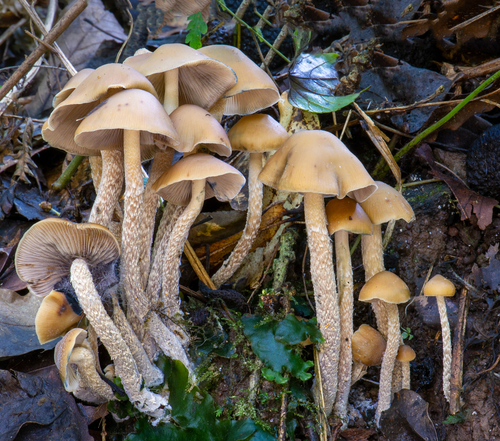
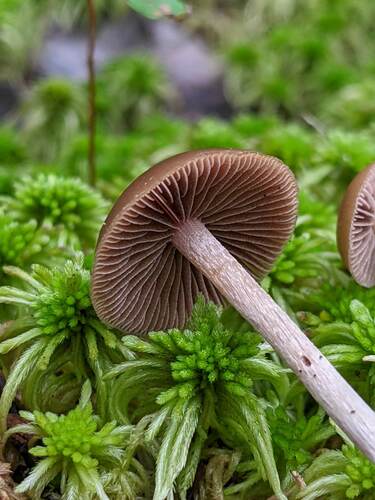
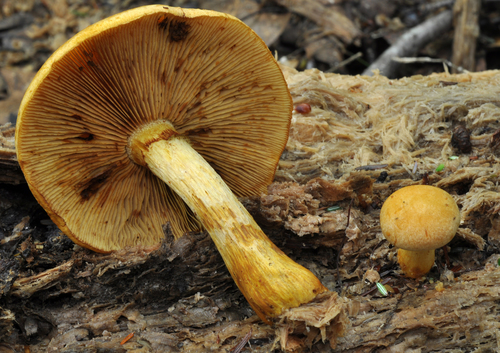
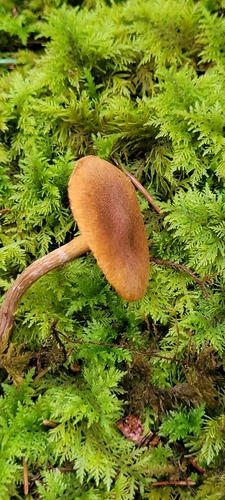
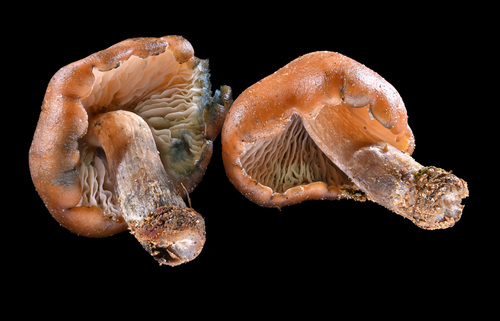
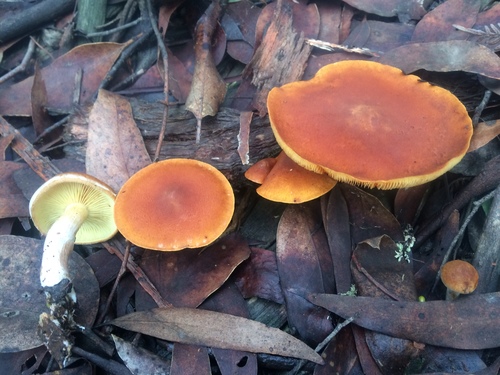
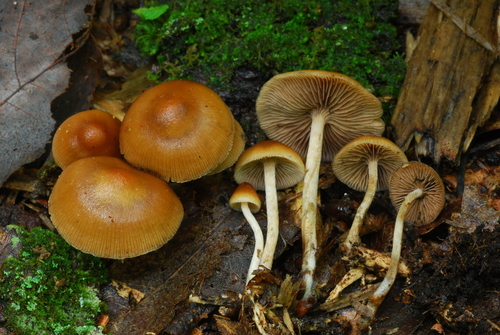
Psilocybe caerulipes has a farinaceous taste and no to only slightly farinaceous odor. Its cap measures 1 to 3.5 cm in diameter, and ranges from an obtusely conic to convex shape. The cap margin is initially turned inwards; later the cap becomes broadly convex to flattened or somewhat umbilicate while retaining a slight umbo, and can sometimes be quite irregular. The cap surface is viscid when moist due to a gelatinous pellicle, but quickly becomes dry and shiny. It is translucent-striate, marked with fine fibrillose veil remnants, and often has greenish stains near the margin or a greenish tinge across the whole cap. When fresh, the cap is cinnamon brown to caramel brown, it is hygrophanous, and quickly fades to a dingy ochraceous buff during dry conditions. The mushroom's flesh is thin and pliant, and bruises blue, sometimes slowly. The gills are close but not crowded, narrow, with attachment ranging from adnate to sinuate to uncinate. They are nearly white when young, turning dark brown as spores mature; the gill edges are whitish and slightly fimbriate. Spores are dark brown and ellipsoid. Spores from 4-spored basidia measure 7–10 x 4–5 μm, are thick-walled, and have a broad germ pore. Spores from 2-spored basidia are larger. The stipe is 3–6 cm long and 1.5–3 mm thick, it is equal in width or enlarges downwards, and has a tough, ropey texture. When young, the stipe is whitish to brown. When dried, it becomes pallid to bluish, and turns dingy brown toward the base with age; it bruises blue, sometimes slowly. The stipe surface is powdered at the apex, and covered with whitish to grayish fibrils further down. The stipe flesh is stuffed with a pith, starting solid before becoming hollow. The stipe does not have a persistent annulus, but sometimes remnants of the thin cortinate partial veil leave a fibrillose annular zone in the upper stem that disappears quickly. For microscopic features: basidia are both 2-spored and 4-spored. Pleurocystidia are absent. Cheilocystidia measure 18–35 x 4.5–7.5 μm, are langeniform, meaning swollen at the base and narrowed at the top, with a thin neck that is sometimes forked, and measure 1–2.5 μm broad at their apices. In terms of habitat, Psilocybe caerulipes grows solitary to cespitose in deciduous forests. It grows on hardwood slash and debris, plant matter, and on or around decaying hardwood logs, including those of birch, beech and maple. For distribution, Psilocybe caerulipes occurs in eastern North America, ranging from Nova Scotia to North Carolina, and west to Michigan. It has also been found as far south as Mexico, in the states of Hidalgo and Veracruz, where it grows in cloud forests on Fagus. It is often overlooked as another small brown mushroom, and despite being widely distributed, it is not encountered very often. It is sometimes confused with the larger species Psilocybe ovoideocystidiata.