About Psilocybe azurescens Stamets & Gartz
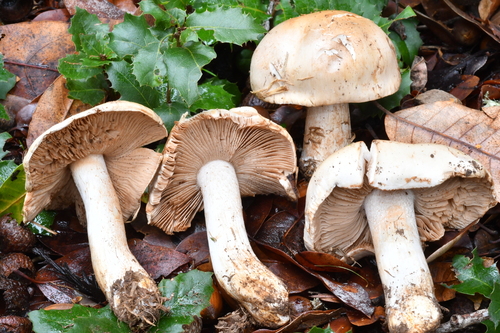
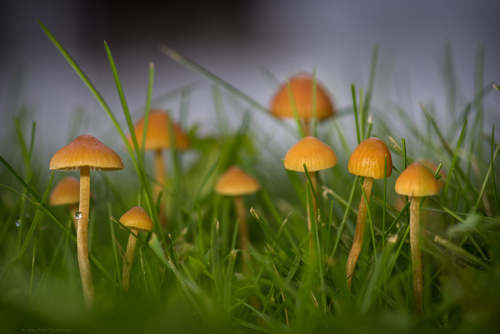
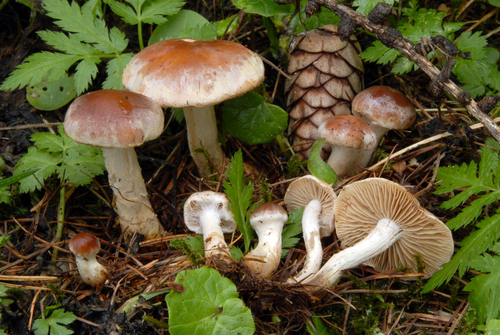
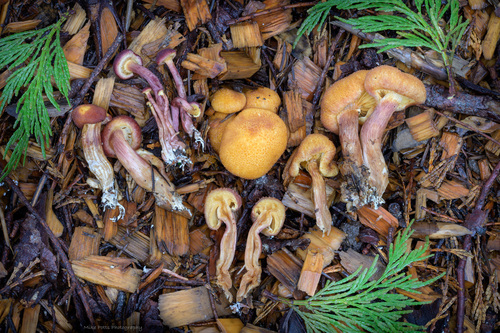
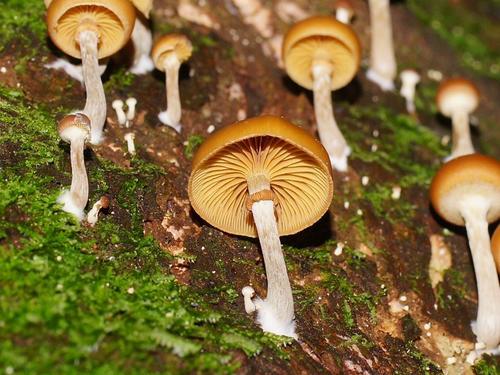
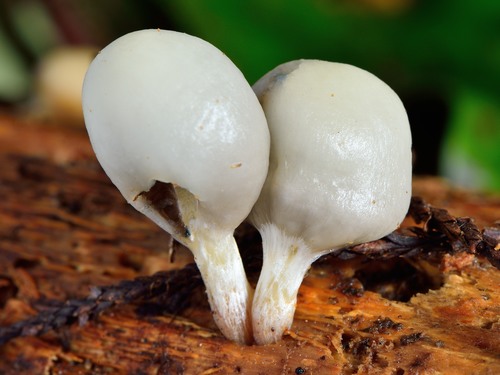
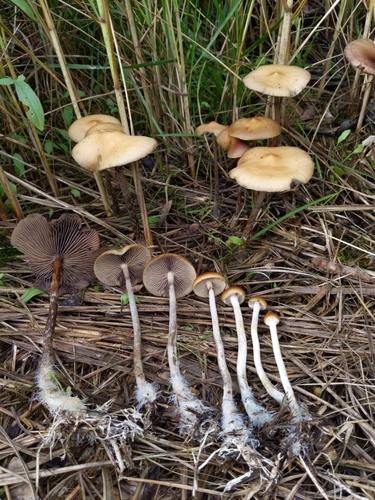
Psilocybe azurescens Stamets & Gartz has a cap (pileus) 3–10 cm (1.2–3.9 in) in diameter. The cap starts conic to convex, expands to broadly convex, and eventually flattens with age; it always retains a distinct, persistent broad umbo. When moist, the cap surface is smooth, viscous, and covered by a separable gelatinous pellicle. Cap color ranges from chestnut to ochraceous brown to caramel, and often develops dark blue or bluish black pitted zones. The cap is hygrophanous: it fades to a light straw color as it dries, and bruises strongly blue when damaged. The cap margin is even, and may become irregular or eroded at maturity. It is slightly incurved when young, and becomes decurved as the mushroom ages. The cap is translucent striate, and often leaves a fibrillose annular zone on the upper portion of the stipe. The lamellae (gills) are ascending, with a sinuate to adnate attachment to the stipe. They are brown, stain black when injured, are closely spaced, arranged in two tiers, and have whitish edges. The spore print of Psilocybe azurescens is dark purplish brown to purplish black. The stipe is 9–20 cm (3.5–7.9 in) long and 3–6 mm (0.1–0.2 in) thick. It is thick, with a color that shifts from silky white when young to dingy brown with age. At maturity, the stipe is hollow, made of twisted, cartilaginous tissue. The base of the stipe thickens toward its end, is often curved, and has coarse white aerial tufts of mycelium that often carry distinct azure blue tones. The mycelium around the stipe base is densely rhizomorphic (root-like), silky white, and holds wood chips together tightly. This mushroom has an extremely bitter taste, and ranges from odorless to having a starchy scent. In the wild, Psilocybe azurescens grows naturally along a small stretch of the United States West Coast, including parts of Oregon and California. Documented natural populations range as far south as Depoe Bay, Oregon, and as far north as Grays Harbor County, Washington. Its main natural locations cluster around the Columbia River Delta: the first type collections were collected in Hammond, Oregon, near Astoria. It is also very common north of the Columbia River in Washington, from Long Beach north to Westport. Feral specimens have also been reported in Stuttgart, Germany. While uncommon, it can sometimes be found growing around decaying wood in Oregon's Willamette Valley, where psilocybin was decriminalized in 2020. Ilwaco, Washington also hosts a large population, but harvesting here is a potential misdemeanor enforced by local law enforcement. This species prefers to grow either caespitose (in tight, separate clusters) or gregariously on deciduous wood chips, and/or in sandy soils rich in woody (lignicolous) debris. It often grows in association with coastal dune grasses. It forms an extensive, dense, tenacious mycelial mat called a collyboid mat, and causes wood to lighten (whiten) as it grows. Fruitings start in late September and continue through late December to early January, as documented by mycologist Paul Stamets. Psilocybe azurescens has been cultivated in many countries including Germany, the Netherlands, New Zealand, the United Kingdom, and its native United States—especially in the states of California, New Mexico, Ohio, Oregon, Washington, Vermont, Wisconsin, and Pennsylvania.