About Psilocybe aztecorum R.Heim
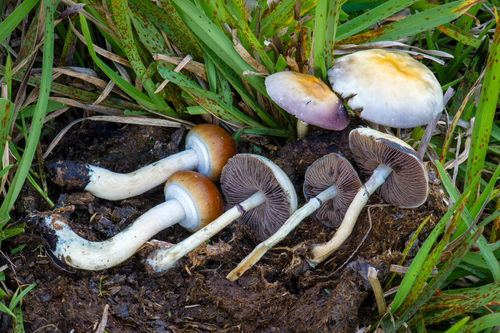
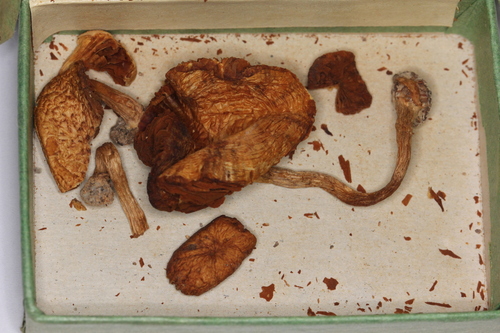
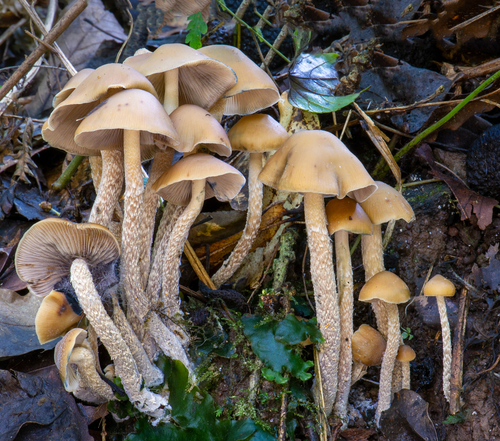
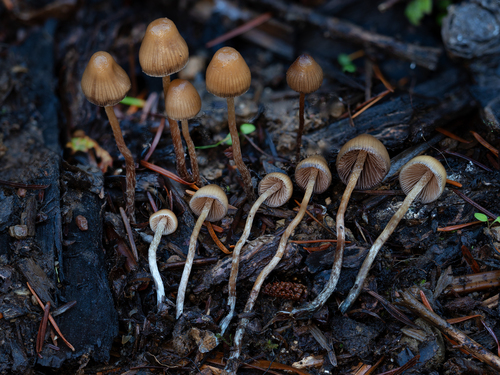
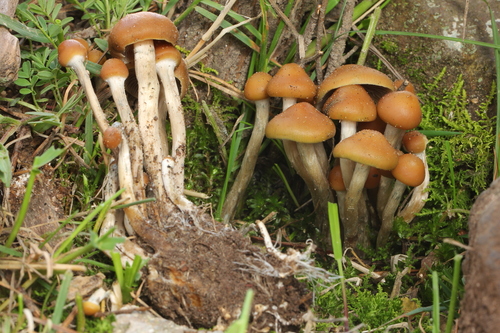
Psilocybe aztecorum R.Heim has a cap that starts convex to bell-shaped, sometimes developing a broad umbo before expanding and flattening as it ages. Its diameter reaches 1.5–2 cm (0.6–0.8 in). When mature, the cap eventually forms a central depression, and in some old specimens, it opens into the hollow stem. The cap surface is slimy to the touch, and has translucent striations along the margin when moist. It is strongly hygrophanous, meaning its color changes based on hydration level. Color ranges from yellowish brown to golden yellow in young button-shaped specimens, shifting to brownish gray with greenish-gray tints on the margin with age. The color later changes to whitish from the center outward to the margin, finally turning completely white; dried specimens are straw-colored to pale brownish. Unlike most psilocybin mushrooms, the cap of P. aztecorum does not have a strong bluing reaction after injury—only the margin stains slightly green-blue. The gills are adnate (broadly attached to the stem slightly above the bottom of the gill) or adnexed (reaching the stem, but not attached to it), and are light violet gray to dark violet brown. They are either uniform in color, or have whitish edges. The hollow stem is 5.5 to 7.5 cm (2.2 to 3.0 in) long by 3 to 4 mm (0.12 to 0.16 in) thick, equal in width throughout or thicker at the top, cylindric or sometimes flattened, and either straight or curved and twisted. Its surface is smooth, silky-fibrillose, whitish to greyish, and stains blue-green irregularly when touched or as it ages. The base of the stem is densely covered with well-developed white rhizomorphs. Young mushrooms have a white cobweb-like partial veil that does not last long before disappearing, although it sometimes remains as a non-permanent ring on the upper part of the stem. The flesh is whitish to yellowish or reddish yellow in the cap, or reddish brown in the stem, and shows little or no bluing reaction to injury. Like most bluing Psilocybe mushrooms, the odor and taste of P. aztecorum is slightly farinaceous (similar to freshly ground flour) in fresh specimens; dried specimens have a more intense odor. A drop of dilute potassium hydroxide (KOH) stains the cap, stem, and flesh reddish brown; sometimes, the stem does not stain or stains slightly yellowish red. The spore print is blackish violet.
For microscopic characteristics: Spores are elongated-ellipsoid in face view, roughly terete (more or less cylindrical, usually tapering at both ends), and slightly inequilateral or asymmetrical in side view—the so-called "mango" form. They typically measure 12–14 by 6.6–7.7 by 6–7.5 μm, although some spores have irregular shapes and are strongly elongated, reaching up to 23 μm. Spores are thick-walled (generally between 1–1.5 μm), dark yellowish brown, and have a broad germ pore. The variety bonetii has smaller spores measuring 10–13 by 6–7.5 by 6–7 μm. The basidia (spore-bearing cells) measure 24–33 by 6.6–8.8 μm, and may attach to one to four spores, with four-spored basidia being most common. They are hyaline to sometimes somewhat yellowish, club-shaped or roughly cylindrical, and some have a slight constriction around the middle. The cheilocystidia (cystidia on the edge of a gill) are abundant, forming a sterile band on the gill edge. They are hyaline, fusoid-ampullaceous (shaped from a spindle to a swollen bottle), with dimensions of 20–45 by 5–8.2 μm, and have a filamentous neck measuring 6–11 by 1.6–2.5 μm. The pleurocystidia (cystidia on the gill face) are scattered, similar to cheilocystidia in form and size, hyaline, and some have bifurcated or branched necks. The subhymenium (a layer of cells immediately below the hymenium) consists of spherical cells interwoven with hyphae; this layer is hyaline to yellowish or brownish, and does not have pigment crusted on hyphae walls. The epicutis (the upper of two layers of the cap cuticle) is made of a thin gelatinous layer of hyaline or brownish hyphae measuring 1.5–2.5 μm in diameter. The hypodermium (the cuticle tissue layer under the epicutis) is hyaline, and has elongated to roughly spherical hyphae that are 10–18 μm in diameter. Clamp connections are present in the hyphae of P. aztecorum.
P. aztecorum is a lignicolous species, meaning it grows on and decays dead wood, leaves, sticks, or other similar organic debris. Mushrooms typically fruit in groups of 5 to 20, sometimes in bundles. Common substrates include wood debris buried in soil, twigs or very rotten logs, and rarely, pine cones. It is found in woodlands (low-density forest or wooded areas that let sunlight reach the forest floor) containing Hartweg's pine (Pinus hartwegii), alongside grasses such as Festuca tolucensis and Muhlenbergia quadridentata, and the herbaceous plant Alchemilla procumbens, at elevations of 3,200–4,000 m (10,500–13,100 ft). The type specimens were found by Heim at an altitude of 3,500 m (11,500 ft) in an alpine pine forest. P. aztecorum fruits from August to October. It is known only from the high mountains of central Mexico, including Sierra Nevada, Nevado de Toluca, and La Malinche in the states of Mexico, Puebla, and Tlaxcala. Guzmán notes it is likely the species also grows in other high mountain areas such as the states of Nuevo Leon, Veracruz, Colima, and Chiapas, which have ecological conditions similar to the known localities. Variety bonetii grows on the same substrates as the type variety, mainly on humus, but only in forests with Montezuma pine (Pinus montezumae) and sacred fir (Abies religiosa), between 2,000–3,300 m (6,600–10,800 ft) elevation; it has not been recorded from Hartweg's pine forests. Also known only from Mexico, in the states of Mexico and Morelos, and in the Federal District, P. aztecorum var. bonetii usually fruits from August to November. Guzmán states P. aztecorum should be a conservation concern due to loss of its natural habitat.
Psilocybe aztecorum contains the psychoactive compound psilocybin. In 1958, Swiss chemist Albert Hofmann reported a relatively low psilocybin concentration of 0.02%, but this analysis was performed on two-year-old specimens. Jonathan Ott and Guzmán confirmed psilocybin is present in variety bonetii. Paul Stamets rates P. aztecorum as "moderately to highly active" in psychoactive potency. The 16th-century stone effigy of the Aztec "god of flowers", Xochipilli, unearthed on the side of the volcano Popocatépetl, depicts a single seated cross-legged figure on a temple-like base; his body is covered in carvings of sacred and psychoactive organisms. R. Gordon Wasson interpreted circular patterns on his kneecaps, right forearm, and headdress as stylized fruit bodies of Psilocybe aztecorum. Wasson notes the convex shape and incurved margins shown in these images match mushroom caps just before maturity. Alongside P. caerulescens, P. aztecorum is one of two mushrooms thought to be the species described by 16th-century Spanish chronicler Bernardino de Sahagún as teonanácatl. The Nahuatl word teonanácatl has been translated variously as "sacred or divine mushroom" or "flesh of the gods". These mushrooms, considered holy sacraments by the Aztecs, were consumed during spiritual and divinatory rituals to induce hallucinatory visions. P. aztecorum is still used ceremonially by indigenous people of Oaxaca, and by Nahua people in the Popocatépetl region, though this usage is gradually diminishing. Traditional folk healers, or curanderos, remain familiar with psychoactive mushrooms and other mind-altering plants used in ceremonial rituals, and diagnose illnesses by having clients ingest the mushrooms. One Mixe curandero initiation ritual involves mushroom ingestion after a three-day period of "abstinence from talking, sexual intercourse, and all foods except nuts, whereupon the individual goes up to a mountain, subsists on nothing but a little honey, and prays to God for the power to heal."