About Psilocybe angulospora Yen W.Wang & S.S.Tzean
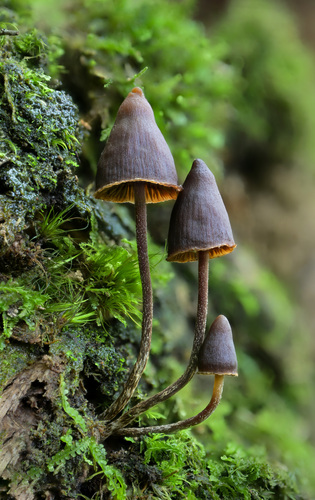
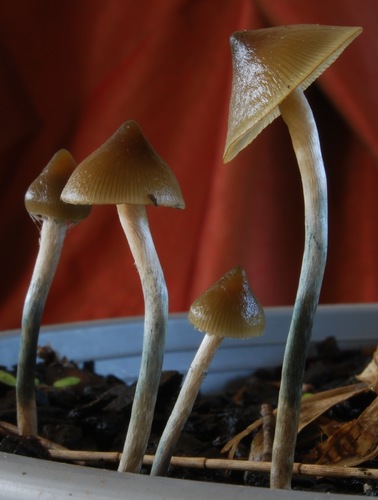
Psilocybe angulospora Yen W.Wang & S.S.Tzean has a cap 10–40 mm in diameter, with colors ranging from light brown to medium grey blue. Cap shape is conic to subcampanulate, which is cone-like to bell-shaped, with an inrolled margin and often an acute central papilla. When moist, the cap is translucent-striate to the margin, meaning fine radial lines are visible around the cap edge. It is extremely hygrophanous, glabrous (smooth and free of surface ornamentation), and slightly fibrous. The cap flesh is firm, and colored brownish orange to yellowish. The gills are pale, thin, and fairly close together. They are narrowly adnate, meaning the gills are broadly attached to the stipe by most of their width. There are one to three short intermediate gills between any two larger intermediate gills, and the gills have a smooth edge. The stipe measures 40–70 mm long by 1–2 mm thick, is pale greyish white, cylindrical, centrally positioned, and fibrous, with brownish orange to yellowish stipe flesh. It may be hollow, or stuffed with fibres. A partial veil sometimes leaves a fragile line of raised threadlike tissue around the stipe, located close to halfway down the stipe. This tissue can resemble a faint, thin raised ring, and is often stained blue. This species was formally described by Yen-Wen Wang and Shean-Shong Tzean in the 2015 publication "Dung-associated, Potentially Hallucinogenic Mushrooms from Taiwan", archived April 22, 2018 at the Wayback Machine. For habitat and distribution, Psilocybe angulospora grows scattered on heavily manured grassland soil and directly on cow dung at Qingtiangang in Yangmingshan National Park, Taiwan. It also occurs in potted plants and woodchip landscaping in New Zealand.