About Psilocybe alutacea Y.S.Chang & A.K.Mills
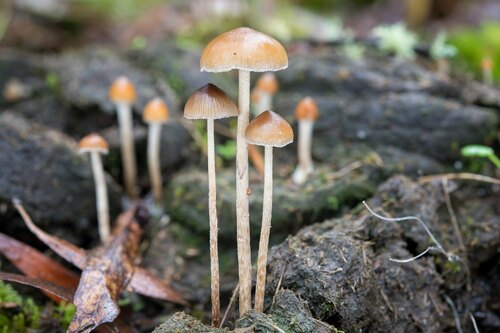
Psilocybe alutacea Y.S.Chang & A.K.Mills has a 10–13 mm diameter cap that is conical to convex in shape. When moist, the cap is somewhat sticky or tacky, and it is hygrophanous, meaning it changes colour abruptly when shifting from wet to dry. The cap surface is smooth, radially striate along its edge, and ranges in colour from leathery brown to ochraceous brown. Its gills are adnate, subdistant, and greyish brown with white edges, and they sometimes have uneven colouring. The stipe is 25–46 mm long by 1–2.5 mm thick, pale brown, cylindrical, and stuffed. A blueing reaction occurs when the fungus is damaged, but this reaction is faint and slow, and only appears at the edges of the gills, and occasionally on the stipe. The spore print of this species is purple-brown. Under microscopic observation, spores measure 11.7-15.8 (-16.7) x 7.9-9.2 μm, are ellipsoid, and have a distinct germ pore. Basidia measure 25.8 - 34.2 x 9.2-12.1 μm, are 4-spored, transparent, and shaped like a club or inverted egg. Cheilocystidia measure 22.5-35.9 (-44.2) x 5 - 10 μm, are transparent with 6.7-15 μm long necks, and can be simple, bifurcate, or trifurcate, meaning they have one, two, or three prongs or forks. Pleurocystidia are rare in this species; they measure 17.5-30.4 x 4.6 - 10 μm, and are lageniform (shaped like a bottle or flask) with long necks. The subhymenium is subcellular. The trama is regular, turns pale brown in 5% KOH, and has hyphae that measure 3.3-15 μm. The epicutis is a layer of subgelatinised, encrusted hyphae that contain brown pigments, and these hyphae are 2.5-5 μm wide. Clamp connections are present. This species is distributed in Australia and New Zealand. In Tasmania, collections have been made at Snug Falls Track, Mount Field National Park (Pandanus Walk), and Kermandie Falls (Upper Track). It grows solitary to sub-gregarious on cow dung, and has also been collected on horse and wombat dung. It sometimes occurs in leaf litter, or in soil within mossy areas.