About Psilocybe allenii Borov., Rockefeller & P.G.Werner
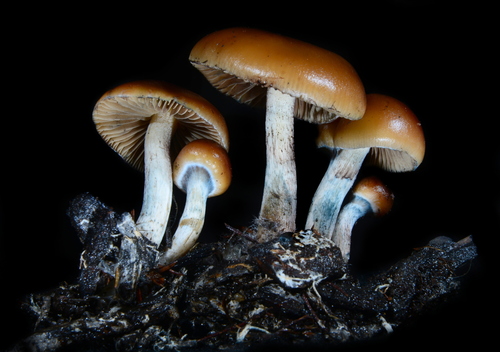
Fruitbodies of Psilocybe allenii vary in size based on the substrate they grow in. Caps measure 1.5–9 cm (0.6–3.5 in) across, ranging from broadly convex to flattened, and sometimes develop a slight depression in the center. The cap margin is either straight and slightly curved inward, rarely slightly wavy, and may have radial grooves on moist specimens. The cap surface is smooth, sticky when moist, and has a gelatinous cap cuticle that can be peeled. Wet fruitbodies are slippery enough to be difficult to collect. Caps are hygrophanous, meaning their color changes with moisture level: they are pale orange brown to caramel brown when moist, and dry to yellowish-buff. Gills attach to the stipe in an adnate to sinuate arrangement; they start cream to pale gray brown, then turn dark purple as spores mature. The stipe is cylindrical, hollow, typically 4–7 cm (1.6–2.8 in) long by 0.2–0.7 cm (0.1–0.3 in) thick, with a slightly thicker base. The top of the stipe is pruinose, meaning it is covered in white powdery granules, while the base connects to thick white rhizomorphs. The stipe surface ranges from smooth to silky fibrillose, with a texture like fine silky fibers; it is initially white and yellows slightly with age. The mycelium at the stipe base is white or stained blue, and all parts of the fruitbody stain blue when bruised or handled. Young specimens have a white partial veil that disappears as the mushroom matures, or may remain as a ring-like zone on the stipe that can be colored purplish brown by spores. The odor and taste of the mushroom is farinaceous, similar to freshly ground flour. Spore prints are dark brown, sometimes with violet tints. Spores have thick walls and an apical pore; they are elongated ellipsoid to equilateral when viewed face-on, somewhat inequilateral when viewed from the side, and typically measure 12.0–12.6–13.1 by 6.8–7.1–7.4 μm. The spore-bearing basidia are cylindrical, four-spored with sterigmata up to 5.5 μm long, and measure 27–37 by 9–11 μm. Clamp connections are present in the hyphae. Cheilocystidia (cystidia on the gill edge) are abundant. They are translucent, thin-walled, variably shaped from narrow clubs to narrow flasks with a neck no longer than 8 μm, and typically measure 20–30 by 6–8 μm. Pleurocystidia (found on the gill face) are common; they are broadly club-shaped, tapering to a point, and occasionally have a rounded tip, measuring 25–35 by 9–14 μm. Caulocystidia found on the stipe are also present, with variable shapes similar to cheilocystidia and pleurocystidia. These mushrooms are consumed for their psychoactive properties, and have a potency roughly similar to Psilocybe cyanescens. Borovička and colleagues note that the species is "commonly sought out by some mushroom hunters". According to Rockefeller: "If you go to Golden Gate Park in December you will see hundreds of hippies looking at the wood chip landscaping for Psilocybe cyanescens and Psilocybe allenii." Psilocybe allenii occurs in northwestern North America, with a range extending from British Columbia south to Los Angeles, California. It is most common within 10 miles (16 km) of the Pacific coast, though it has been collected as far as 100 miles (160 km) inland. Fruitbodies grow scattered, in groups, or more rarely in clusters, on woody debris such as the wood chips commonly used in landscaping. Preferred substrates include hardwood mulches from oak, eucalyptus, Douglas fir, and alder. Fruiting occurs in cold weather, generally from late September to January. This species can be readily cultivated on agar, grain spawn, and cellulosic materials including wood chips and sawdust.