About Psidium sartorianum (O.Berg) Nied.
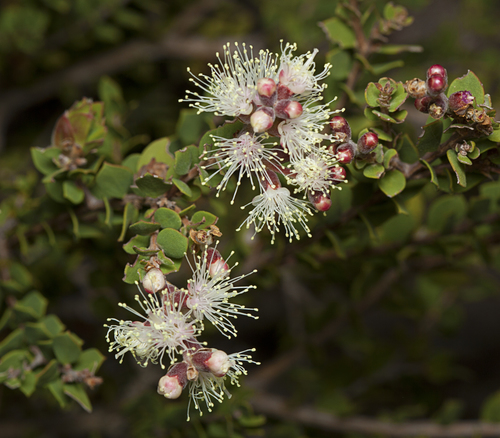
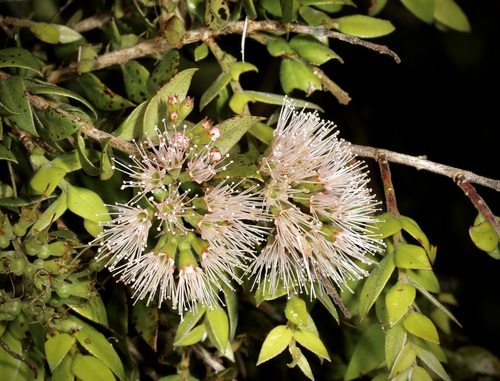
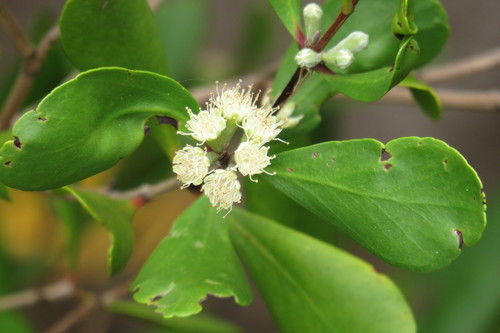
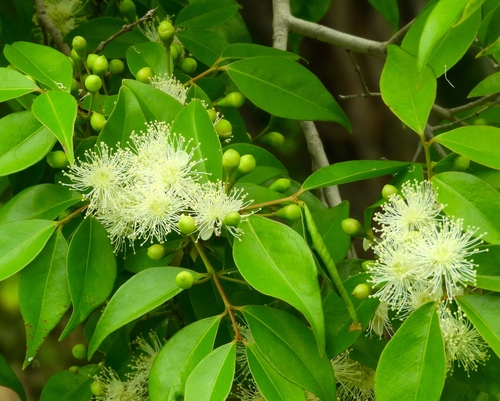
Psidium sartorianum (O.Berg) Nied., also referred to as Psidium oligospermum in this description, grows as either a small tree or a shrub. It reaches up to 8 m (26 ft) in height and up to 1 m (3 ft 3 in) in trunk diameter, and has smooth, pinkish-grey bark. It produces wide-spreading branches; its dotted grey branchlets bear reddish to white or yellowish trichomes (hairs). Branchlets tend to become smoother along their edges, with bark growing more stringy, and terminal branchlets and leaves are sometimes covered in a scurfy reddish bloom. Its leaves are arranged oppositely, and shaped elliptic to ovate, with leaf tips ranging from acute to acuminate. The leaf base is narrowly cuneate and decurrent along the leaf petiole. Entire leaves are glabrous, and are generally darker on the upper leaf surface and paler on the lower surface. Leaves are typically 21–54 mm (0.83–2.13 in) long and 9–26 mm (0.35–1.02 in) wide, and petioles (leaf stalks) are generally 1–3 mm (0.039–0.118 in) long. The buds of this plant are pear-shaped (pyriform), connected to the base of the branchlet and extending 1–1.5 mm (0.039–0.059 in) outward. The bud is glabrous except for a tiny pore at its apex, where a few trichomes protrude 4–5 mm (0.16–0.20 in) outward. Flowers are white, borne on recently grown branches, and are relatively small, measuring 1–1.5 cm (0.39–0.59 in) in diameter. Its berries are spherical and glabrous, marked with ripples created by internal glands. Mature berries are yellow, and turn black or reddish-brown when dried. They measure 6–13 mm (0.24–0.51 in) in diameter, and the pericarp (berry wall) is about 1 mm (0.039 in) thick. Seeds are angular, dark, 5 mm (0.20 in) long, with several seeds held in each locule. In the Galápagos Islands, this plant is found on Fernandina, Isabella, Pinta, Santa Cruz, and Santiago islands. It typically grows in arid lowlands and moist uplands. On Socorro Island, part of the Revillagigedo Islands, it acts as a canopy tree in upper-elevation Ilex socorroensis forest, growing alongside Ilex socorroensis, Guettarda insularis, and Sideroxylon socorrense. The berries are edible, reported to have a faint turpentine-like taste, and geese frequently consume the berries. Local people in the Galápagos Islands use the tree’s wood for fencing and as a building material, though the wood is not very hardy or long-lasting.