About Psidium guajava L.
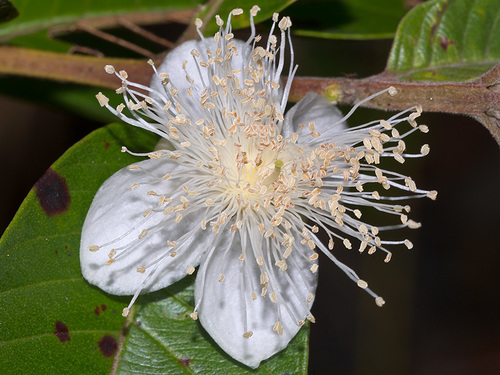
Psidium guajava L., commonly known as guava, is widely cultivated across tropical and subtropical regions worldwide. Its fruits vary in size from as small as an apricot to as large as a grapefruit. Different cultivars produce fruits with white, pink, or red flesh; a small number of varieties have red skin, rather than the more common green or yellow skin. Guavas grown from seed are known for having an extremely slow growth rate for the first several months, after which their growth speeds up very quickly. Seed-grown common guavas can bloom and produce fruit anywhere from as early as two years after planting to as late as eight years after planting. Propagation via cuttings, grafting, and air layering is more commonly used in commercial guava groves. Guavas are highly adaptable, and can be grown easily as container plants in temperate regions, though their ability to bloom and set fruit is somewhat less predictable in these areas. Guava is native to the Caribbean, Central America, and South America. It is a perennial tree that grows well in full sun and warm temperatures, so it grows in many countries with tropical or subtropical climates. It can be found growing along roadsides, in grasslands, and at elevations from near sea level up to 1,600 metres (5,200 ft), and is most prevalent in humid grasslands. In some tropical areas, guava can become an invasive species, and it has become a major invasive problem in the Galápagos Islands. Guava produces an edible fruit that can be eaten either raw or cooked. Processing guava fruits creates by-products that can be used as feed for livestock, and the leaves can also be used as fodder. Phasmid breeders also use guava to feed a range of stick insect and leaf insect species, including Extatosoma tiaratum, Eurycnema goliath, Pulchriphyllium giganteum, Pulchriphyllium bioculatum, and Phyllium monteithi. Guava wood harvested in Hawaii is commonly used for smoking meat. The wood is naturally resistant to insect and fungal damage. Oven-dry guava wood has a density of approximately 670 kg/m3 (1,130 lb/cu yd), and has been found to be suitable for use in roof trusses in Nigeria. Many cultures across Central America, the Caribbean, Africa, and Asia have used Psidium guajava in traditional medicine to treat inflammation, diabetes, hypertension, caries, wounds, pain, fever, diarrhea, rheumatism, lung diseases, and ulcers. The plant is added to many different shampoo products for its scent. It is also growing in popularity as a bonsai species, and is currently quite popular for this use in India and Eastern Asia.