About Pseudovanilla foliata (F.Muell.) Garay
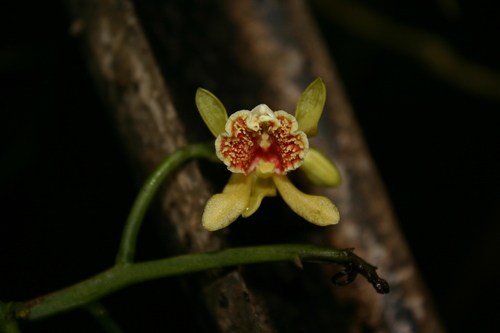
Pseudovanilla foliata is a terrestrial, perennial, completely hairless vine. Its yellow-green stem is typically flexuose and cylindrical, reaching up to 0.9 cm (0.35 in) in diameter and 15 m (49 ft) in length. Thin, elongated flexuose adventitious roots grow from its stem nodes, and each root is always accompanied by an opposite bract, which serves as a useful distinguishing feature for the species. Leaves are sparsely spaced between nodes; they are elliptical, acute or subacute, slightly fleshy, and grow up to 8 cm (3.1 in) long and 2.5 cm (0.98 in) wide. P. foliata produces a lax, heavily branching inflorescence that holds 4 to 8 flowers at the tip of each offshoot. The inflorescence rachis is slightly swollen, and floral bracts are tiny and triangular. The flowers have yellow sepals and petals, plus a ruffled white labellum marked with orange to pink coloring. Sepals are oblong to strap-shaped, obtuse, 2.6 cm (1.0 in) long and 0.6 cm (0.24 in) wide. Petals are narrow, slightly curved and strap-shaped, with a thickened mid-vein on their outer surface; they match the length of the sepals and measure 0.4 cm (0.16 in) wide. The lip, 2.1 cm (0.83 in) long and 1.6 cm (0.63 in) wide, is broadly elliptic with its base fused (adnate) to the flower's column. Near the lip's tip, it is vaguely three-lobed with wavy margins; lateral lobes are bluntly rounded, and the mid-lobe is semicircular with an indistinct notch. The lip surface is covered in irregular protuberances, and the basal half bears rather long, blunt warts. A keeled callus extends from the lip's base to its midpoint. The flower's column is 1 cm (0.39 in) long, roughly cylindrical and slender, gradually widening slightly toward the apex; the clinandrium has a slightly scalloped edge. The anther is shaped like a square hood and has a small notch on its front edge. The ovary is cylindrical and measures around 1 cm (0.39 in) long. Seed capsules grow 15–25 cm (5.9–9.8 in) long and 4–5 cm (1.6–2.0 in) in diameter. P. foliata flowers between October and January. Pseudovanilla foliata occurs in Queensland, ranging north to Cape York Peninsula and also growing in the region's northeast and central east. Its southernmost range reaches coastal central New South Wales, and separate populations are also found in New Guinea. This species grows at elevations from sea level up to 1,000 m (3,000 ft) in well-developed lowland and upland rainforest, and it is often found growing on live tree trunks or rotting wood such as old stumps and logs. Ecologically, Pseudovanilla foliata can only perform limited photosynthesis in its stems and bracts. It relies heavily on mycoheterotrophic nutrition by parasitizing fungi that grow in decaying wood. Its seeds germinate on decomposing fallen wood, so the species is usually found in areas that have experienced recent ecological disturbance, such as forests affected by cyclones or logging. While P. foliata can grow and spread prolifically on fallen wood, its strong dependence on decomposing fungi means populations eventually decline as the wood breaks down. P. foliata is pollinated by small native bees.