About Pseudotrillium rivale (S.Watson) S.B.Farmer
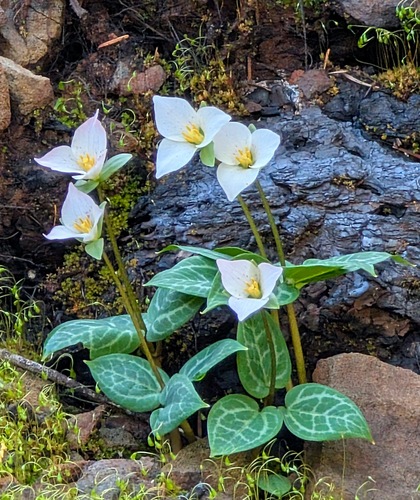
Pseudotrillium rivale is a perennial herbaceous flowering plant that survives via an underground rhizome. Its overall appearance is similar to plants in the genus Trillium, and it was classified as part of that genus in the past. It grows a whorl of three leaf-like bracts, and bears a single trimerous flower that has three sepals, three petals, two whorls of three stamens each, and three carpels fused into a single ovary with three stigmas.
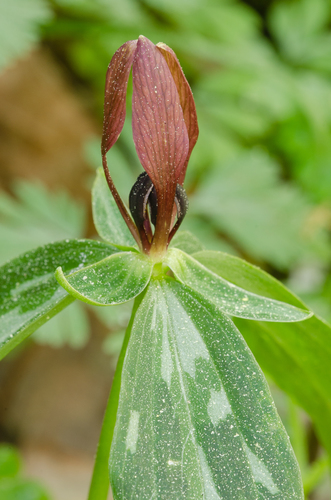
It can be distinguished from true Trillium species by its spotted petals, leathery leaves with a cordate base, and a continually elongating pedicel. When flowering begins, the pedicel holds the flower above the leaves; once the flower is pollinated, the pedicel continues to elongate and bends to place the flower below the leaves. Pseudotrillium rivale reaches a maximum height of 20 cm (7.9 in). Its lance-shaped leaves grow up to 11 cm (4.3 in) long, attached by petioles 1 to 3 cm (0.4 to 1.2 in) in length. The leaves are glossy blue-green with prominent silvery veins.
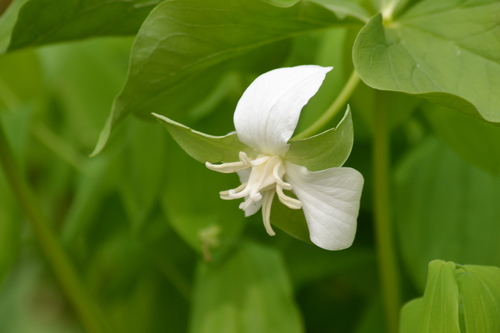
The plant produces a nodding, unscented flower on a pedicel that measures 2.5 to 11 cm (1.0 to 4.3 in) long. Its sepals are green, and its petals are white with a pink blush, growing up to 3 cm (1.2 in) long and 2 cm (0.8 in) wide. Pseudotrillium rivale is endemic to the Siskiyou Mountains, found in southern Oregon (Josephine, Coos, Douglas, and Curry counties) and northern California (Siskiyou and Del Norte counties). It most often grows on ultramafic-origin soils such as serpentine. California specimens, which grow in dense damp woods, are larger in all parts than Oregon specimens and have a strong tendency to produce fully colored flowers. In contrast, Oregon specimens growing in dry open woods are small and have freckled white flowers.
Pseudotrillium rivale flowers from April to June; plants in northern California flower slightly later than those in Oregon, and flowering may be delayed until early May at higher elevations. After flowering finishes, the entire plant may enlarge and become more robust and turgid, with very glossy leaves. Initially the pedicel is moderately sized, but it soon begins to lengthen and twist in an unusual pattern. If fertilization is successful, the pedicel arches downward so the developing fruit touches the soil. By mid-July, the entire plant withers and enters dormancy.
Under its older scientific name Trillium rivale, this plant has received the Royal Horticultural Society's Award of Garden Merit. It is hardy down to −10 °C (14 °F), and requires a sheltered growing position in partial or full shade.