About Pseudoseisura lophotes (Reichenbach, 1853)
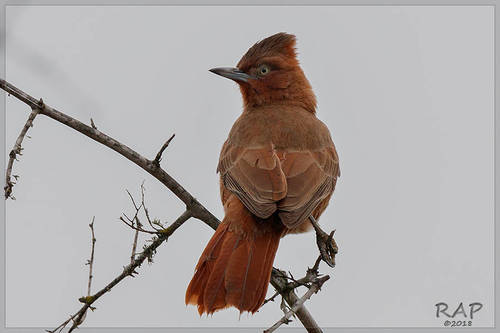
The brown cacholote, Pseudoseisura lophotes, measures 24 to 26 cm (9.4 to 10 in) long and weighs 63 to 79 g (2.2 to 2.8 oz), making it one of the largest species in the furnariid family. Its entire body is covered in rufous plumage, with different shades across different body areas. The lores, the area between the eye and nostrils, and the underside of the tail feathers are slightly darker than the rest of the body. The breast is lighter in color than the throat, which has a particularly vibrant rufous hue. The crest on the top of the head has a jay-like shape and is distinctly dark, along with the primary and secondary flight feathers. Adults have yellow irises, black bills, and legs ranging from grayish-olive to dull greenish. Nestlings have more uniformly colored feet, greener irises, greyer bills, and yellow gape flanges. Both sexes share the same plumage pattern, with males only slightly larger than females. Average measurements for males and females respectively are: 123 mm vs 128.7 mm (4.84 in vs 5.07 in) for wing length, 109.4 mm vs 111.5 mm (4.31 in vs 4.39 in) for tail length, and 26.4 mm vs 27 mm (1.04 in vs 1.06 in) for bill length. This species is very distinct within its habitat and easy to identify. Brown cacholotes sing in duets, usually performed from the tops of trees with fanned tails and spread wings. Their songs are made up of variably noisy, coarse notes that fade toward the end, last at least 25 seconds, and have a pace of roughly 2 notes per second. Its call is a loud "krok" or "cluck". The brown cacholote occurs in the more humid regions of the Gran Chaco and Argentine Espinal north of the Rio Colorado. Its subspecies are allopatric, each occupying its own separate range. The nominate subspecies lives in southern Bolivia and western Paraguay, while the subspecies P. l. argentina occurs in northern and central Argentina, far southern Brazil, and Uruguay. Vagrant individuals have been recorded as far south as Chabut Province. The species inhabits tropical deciduous forest, gallery forest edges, chaco woodlands and scrublands, and also occurs in urban parks and gardens. It ranges in elevation from near sea level to 900 m (3,000 ft), and is a year-round resident across its entire range.