About Pseudoroegneria spicata (Pursh) Á.Löve
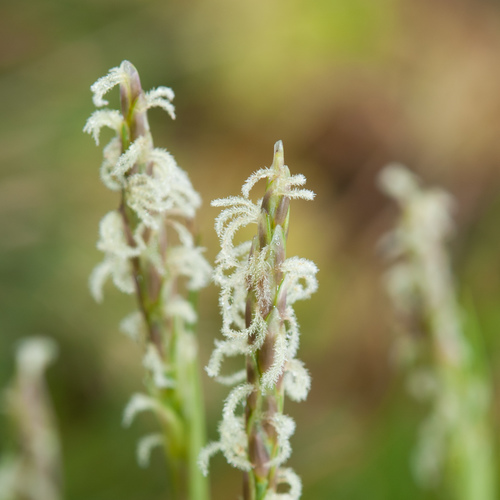
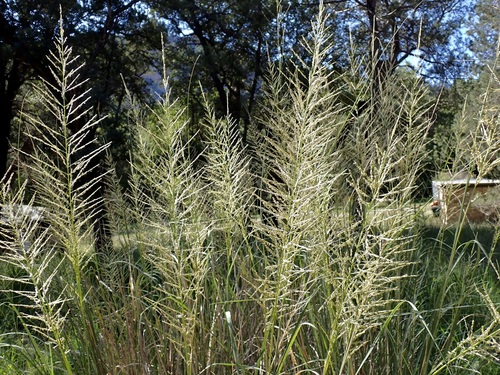
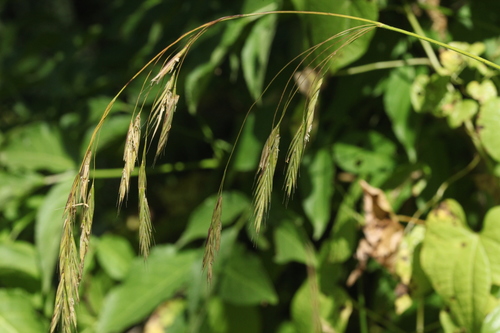
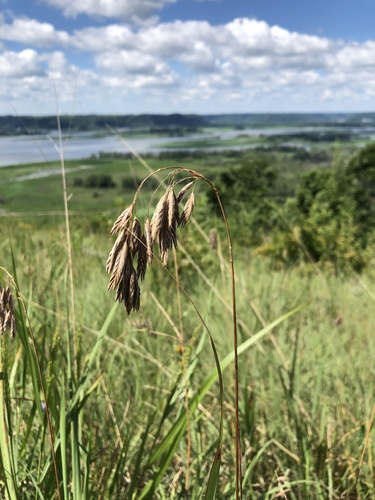
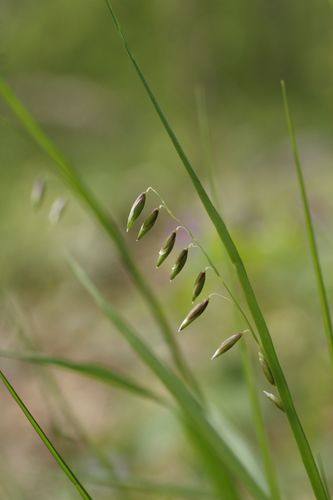
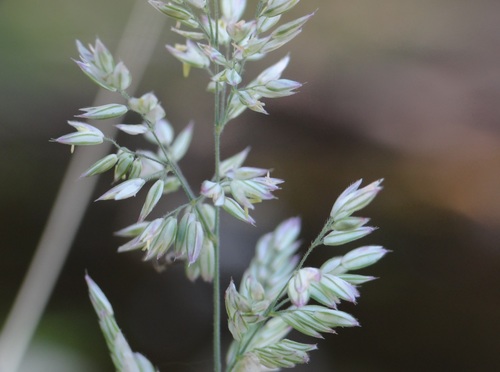
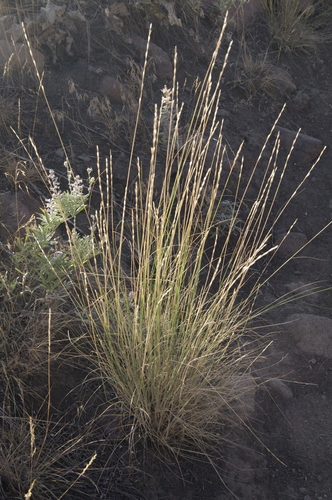
Bluebunch wheatgrass, with the scientific name Pseudoroegneria spicata (Pursh) Á.Löve, can grow up to 0.9 metres (3 feet) tall. It can often be told apart from other bunchgrasses by the awns on its seedheads, which angle outward at nearly 90 degrees from the stem. Its foliage is often bluish in color. The grass’s roots have a waxy layer that helps it resist drying out in dry soils. In areas with higher moisture, this grass may produce rhizomes. The relationship between P. spicata’s traits and local climate matches patterns seen in other grass species that grow during the summer. Populations of P. spicata from warm, arid environments are often smaller, have earlier seasonal growth timing, narrower leaves, and greater leaf hairiness. This differs from P. spicata plants that grow in wetter, higher-nutrient environments, which tend to be larger, taller, and have larger leaves. The stems and leaf sheaths of P. spicata are responsible for most of the species’ photosynthetic carbon uptake during late spring and summer. Additionally, bluebunch wheatgrass invests more biomass and nutrients into its stems and sheaths, which increases its photosynthetic capacity per unit of surface area. Pseudoroegneria spicata is most commonly diploid (2n = 14), though autotetraploid forms (4n = 28) have been found in eastern Washington and northern Idaho. This species occurs in the United States, Canada, and Mexico, ranging from Alaska and Yukon in the north south to Sonora and Nuevo León. It is the dominant grass species in the mountainous regions of the western United States, growing at elevations between 150–3,000 m (490–9,840 ft) in areas that receive 250–500 millimetres (10–19+1⁄2 in) of annual precipitation. It grows in many habitat types, including sagebrush, forests, woodlands, and grasslands. This grass grows best in sandy and clay-rich soils, but it can also grow on thin, rocky soils. It cannot tolerate soils that have high alkalinity, high salt content, or excessive moisture. Pseudoroegneria spicata has extensive drought-resistant root systems that can compete with and suppress the spread of exotic weeds. Its roots also show significant responses when they come into contact with the roots of other plants. When conspecific plants grown at different sites were planted together in pots, the total resulting biomass was 30% higher than in pots that held plants from the same original population or site. Additionally, root elongation decreased after contact with roots from another plant of the same population, compared to contact with roots from a plant of a different population. This pattern suggests that bluebunch wheatgrass roots can detect and avoid intraspecific plants from the same population. The roots of this grass also show notable physiological responses to patches of soil that are enriched with different nutrient solutions, most notably nitrogen, potassium, and phosphorus. This ability to exploit nutrient-rich soil can affect the overall plant’s nutrient status. In phosphorus-enriched environments, the mean root uptake of phosphorus was 5–26% higher than uptake in roots from unenriched control soil patches. Study results for nutrient uptake capacity in potassium-enriched environments show no clear difference between enriched and control soils. This contrasts with nitrogen enrichment experiments, where mean rates of ammonium uptake increased between 22–88%, and mean rates of potassium root uptake were 17–71% higher, in soil enriched with 50 μm of nitrogen, which was the lowest concentration tested in one study. Pseudoroegneria spicata is outcompeted by noxious weeds such as diffuse knapweed (Centaurea diffusa) and medusahead (Taeniatherum caput-medusae). It provides important forage for both livestock and native wildlife in western North America. The species is widely used for revegetation of degraded habitat in the region, and cultivated varieties have been developed.