About Pseudophilotes baton (Bergstrasser, 1779)
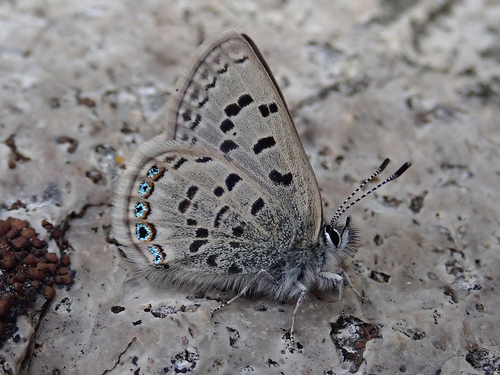
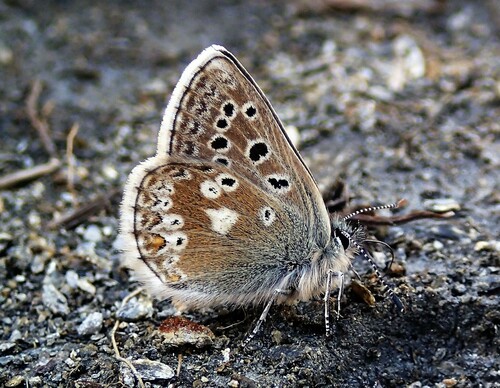
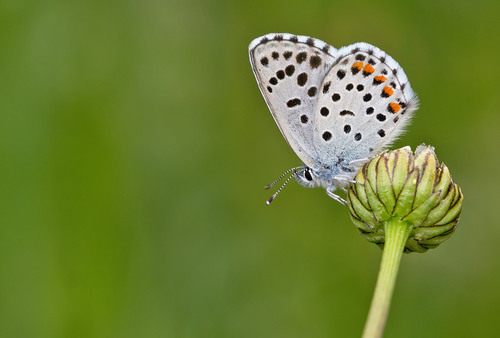
This is the original description of *Pseudophilotes baton*, published in Seitz. Under the synonym L. baton Bgstr. (also called amphion Esp., hylas Schiff.), the species is described as follows. The upperside is blackish; males have more or less blue dusting, the forewing has a distinct discocellular spot, and the fringes are spotted. The underside has numerous ocelli on a leaden grey ground; ocelli are larger on the forewing, which usually even has ocelli near the base. In typical specimens, the hindwing has red-yellow spots before the margin. Its range covers Central and Southern Europe (excluding England), extending from Pomerania and the Baltic Provinces to the Mediterranean, and from Belgium to Central Asia (Altai).
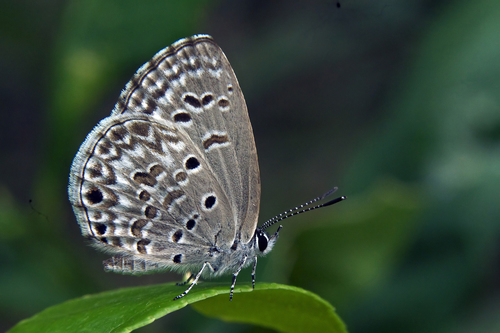
aberration panoptes Hbn. (= argus minutus Esp.) is a form very similar to true baton that lacks reddish yellow anal spots on the underside. It occurs singly among ordinary baton across the range, and is especially abundant in Southern Europe; this taxon is now recognized as the full species Pseudophilotes panoptes (Hübner, [1813]). A similar form found in Spain and North Africa is abencerragus Pier., which also lacks the reddish yellow submarginal band on the underside of the hindwing; the underside of its hindwing is a purer pale dust-grey tint, with distinct but very fine ocelli, and the upperside is very uniform in color. This taxon is now recognized as the full species Pseudophilotes abencerragus (Pierret, 1837). On the southern slopes of the Atlas Mountains, on very arid, almost desert-like slopes, a very small dwarf form that is barely half the size of the common abencerragus of Northern Algeria was frequently caught in spring; it is described as the new form famelica. In Anterior Asia, males have a brighter colour that often has a silvery white sheen; this is clara Christ., now treated as a subspecies of Pseudophilotes vicrama. Pseudophilotes vicrama Moore, now a full species (Pseudophilotes vicrama (Moore, 1865)) from Afghanistan, lacks a distinct discocellular spot on the upperside of the forewing, and also lacks dark marginal dots on the upperside of the hindwing. cashmirensis Moore, a subspecies of Pseudophilotes vicrama from Kashmir, has a distinct black discocellular spot on the upperside of the forewing, just like European forms; additionally, the forewing has whitish marginal lunules and dark veins, and the hindwing has marginal dots.
The larva has strongly keeled lateral surfaces, with somewhat swollen segments. It is light green with a blackish head and rosy-red pyriform dorsal spots that are divided by a purple dorsal line; white dots accompany these spots laterally, and the stigmata are white. Larvae are active in April and again in July, feeding on Thymus, particularly on the flowers; in captivity, they often attack other caterpillars. The pupa is roundish, obtuse, and smooth, it is clay-yellow with darker wing cases, and it develops on the ground.
Adult butterflies are on the wing in May and again in August and September. They frequent very sunny grassy hills and slopes, woodland clearings, and broad sunny roads. They usually fly only very short distances, and settle on grasses and the tops of herbage with their wings half open and widely separated. Their flight is slow, somewhat hopping, and the butterflies are not shy. While they occur more singly in Central Europe, they are extremely common in South Europe and North Africa, where they often fly in great abundance. In the extreme east of their distribution range, in Kashmir, they are restricted to specific locations but very common, according to Butler. Larval host plants include thyme, Clinopodium acinos, lavender, and Mentha.