All Species Plantae

Pseudopediastrum boryanum (Turpin) E.Hegewald is a plant in the Hydrodictyaceae family, order Sphaeropleales, kingdom Plantae. Not known to be toxic.

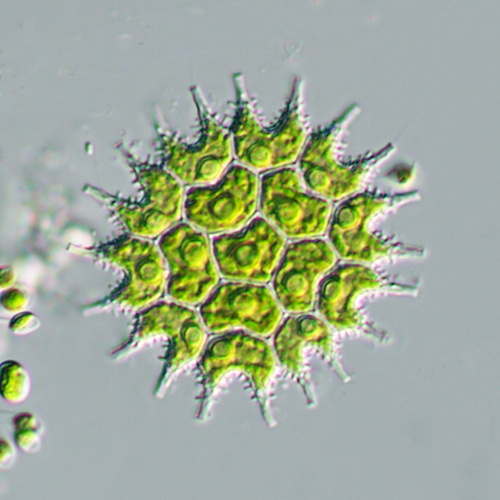
Photo of Pseudopediastrum boryanum (Turpin) E.Hegewald (Pseudopediastrum boryanum (Turpin) E.Hegewald)
Plantae

Pseudopediastrum boryanum (Turpin) E.Hegewald

Pseudopediastrum boryanum (Turpin) E.Hegewald

Pseudopediastrum boryanum is a species of green algae that forms structured star-like colonial coenobia and mostly reproduces asexually.

Identify with AI — Offline
Genus
Pseudopediastrum
Order
Sphaeropleales
Class
Chlorophyceae
⚠️ Toxicity Note

Insufficient toxicity evidence; avoid direct contact and ingestion.

About Pseudopediastrum boryanum (Turpin) E.Hegewald

Colony Structure

Pseudopediastrum boryanum forms colonies called coenobia, which are made up of 4, 8, 16, 32, or 64 cells arranged in a flat, star-shaped disc. Coenobia are usually 25 to 180 micrometers wide.

Inner Cell Morphology

The inner cells of a coenobium are polygonal, typically measuring 6–20 μm in one dimension and 5.7–22.5 μm in the other.

Marginal Cell Morphology

Marginal cells of the coenobium are typically 8–30 μm in one dimension and 9–21 μm wide. These marginal cells have slight to deep notches that create two projections. These projections can grow as long as the rest of the cell, and lie parallel to one another.

Cell Wall Characteristics

The cell wall is reticulate, and covered in granules that sit at the corners of a triangular mesh. It is highly resistant to decay because it contains sporopollenin.

Asexual Reproduction

Like related species, Pseudopediastrum boryanum typically reproduces asexually. It does this by forming zoospores inside the parental cell wall; the zoospores then join together to form new coenobia.

Sexual Reproduction

Isogamous sexual reproduction does occur in this species, but it is only seen rarely.
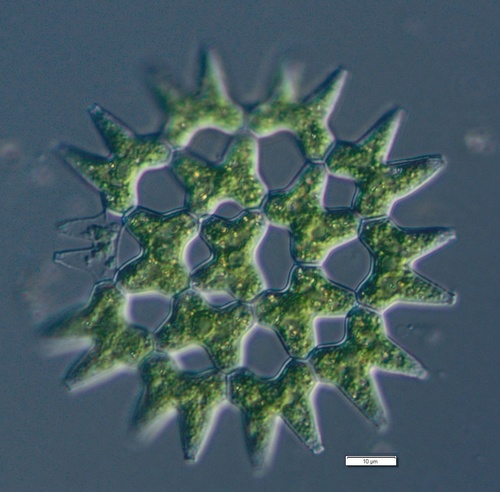
Photo: (c) Glenn McGregor, some rights reserved (CC BY-NC), uploaded by Glenn McGregor · cc-by-nc

Taxonomy

Plantae Chlorophyta Chlorophyceae Sphaeropleales Hydrodictyaceae Pseudopediastrum

More from Hydrodictyaceae

Sources: GBIF, iNaturalist, Wikipedia, NCBI Taxonomy · Disclaimer

Start Exploring Nature Today

Download iNature for free. 10 identifications on us. No account needed. No credit card required.

App Store
Scan to download from App Store

Scan with iPhone camera

Google Play
Scan to download from Google Play

Scan with Android camera

