About Pseudopanthera macularia (Linnaeus, 1758)
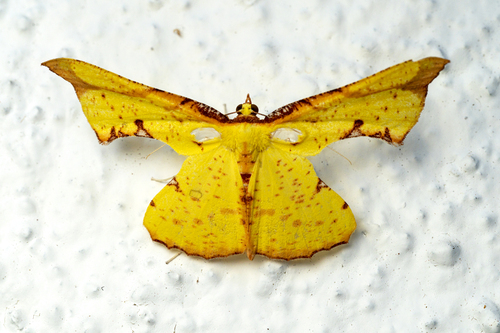
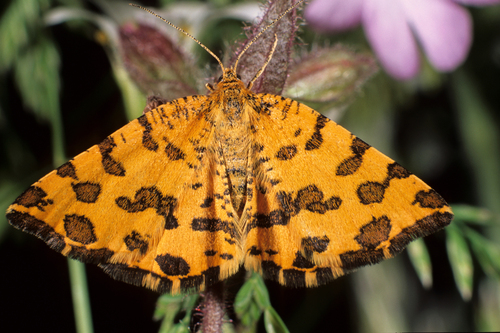
Pseudopanthera macularia, commonly called the speckled yellow, is a moth species belonging to the family Geometridae. It is distributed across Europe, with its range stretching from the Iberian Peninsula through Western and Central Europe, the British Isles, and Russia to the Urals. To the north, its range reaches Southern Fennoscandia, and to the south it extends from the western Mediterranean islands, Italy, and the Balkan peninsula to the Black Sea region and the Caucasus. Starting from Asia Minor, it extends east through the remaining Palearctic region to Transbaikal. This species has a wingspan of 23–28 mm. The typical form is easily recognized by its lines or bands being fully broken into large, irregular spots, which this pattern matches on the wing undersides. A rare aberration, ab. transversaria Krulik, is the only form where the spots, at least on the forewings, are connected to form bands. In ab. viridimaculata Ckll, the spots are colored olive-green. The form ab. albicans Ob. has a whitish ground color for the wings. Ab. quadrimaculata Hatchett is a rare form where most spots are absent, leaving only 4 spots along the costal margin of the forewing. Ab. fuscaria Stgr. (18 c) is another rare form that is entirely fuscous. The subspecies or geographic form meridionalis Galvagni, found in Gorz and Southern Tyrol, has less black dusting and smaller black spots. The larva of Pseudopanthera macularia is green, with white lines and stripes, and a shining green head. From July to September, the larvae feed primarily on woodsage, Teucrium scorodonia. The adult moth is common in woodland habitats, flies during daylight hours, and is active from April to early July, often occurring in large numbers.