About Pseudonaja modesta (Günther, 1872)
Species Nomenclature and Range
The ringed brown snake, scientifically known as Pseudonaja modesta, is a venomous elapid snake species native to a wide area of inland Australia, ranging from western New South Wales and Queensland all the way to Western Australia.
Initial Taxonomic Description
Albert Günther first formally described this species in 1872, classifying it as Cacophis modesta based on specimens collected from northwestern Australia. Its specific epithet modesta is a Latin adjective that means "unassuming", "orderly", or "well-behaved".
Etymology Justification
Toxicologist Struan Sutherland considered this name fitting, as this snake generally does not bite humans.
Synonym Taxon Descriptions
Later, two other scientists described what would later be recognized as the same species: Charles Walter De Vis described Brachysoma sutherlandi in 1884 from a specimen collected at Carl Creek, Norman River in northwestern Queensland, and William Macleay described Furina ramsayi in 1885 from material collected at Milparinka in northwestern New South Wales, naming it in honor of Edward Pierson Ramsay. All three of these described taxa are now considered to be the same single species.
Adult Size
The ringed brown snake reaches an adult length of around 50 cm (20 in).
Dorsal Coloration and Markings
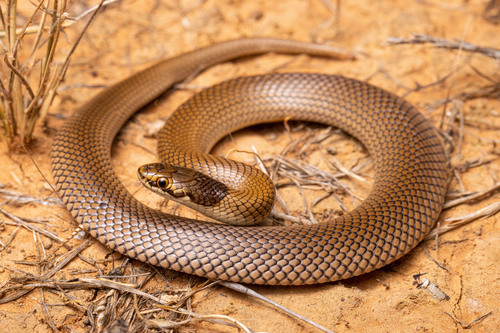
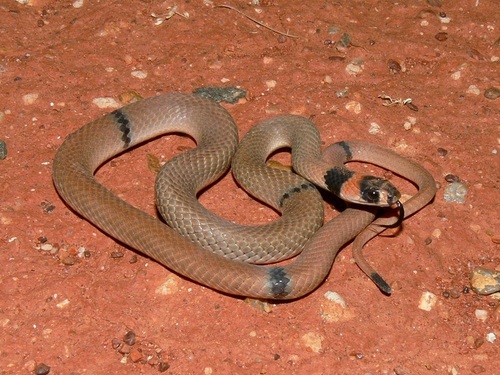
Its upper body is colored grey-brown to red-brown, with a black head and neck that is divided by a cream-colored band. It also has four to seven regular black bands with cream margins running down the length of its body.
Ventral Coloration
Its underbelly ranges from cream to yellow, marked with orange splotches.
Age-Related Marking Changes
The dark upper bands on the snake's body may fade noticeably as the individual ages.
Similar Species Appearance
The ringed brown snake's coloration and markings, especially its black head and neck band, are similar to those of the juvenile eastern brown snake.
Species Distribution
This species occurs across arid regions of inland Australia, and is not found in Victoria.
Habitat Preferences
It inhabits arid shrubland and arid grassland habitats, where it hides in spinifex clumps or under fallen timber.
Bite Symptom Records
In 1987, a girl bitten by this species experienced mild systemic symptoms, and no case of coagulopathy was recorded following the bite.