About Pseudomyrmex pallidus (Smith, 1855)
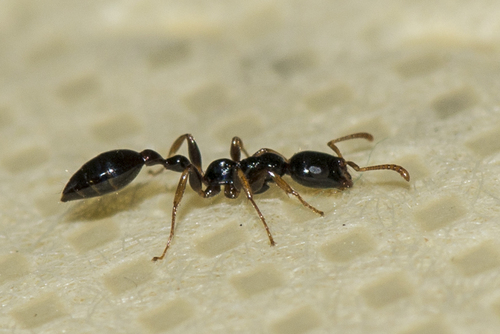
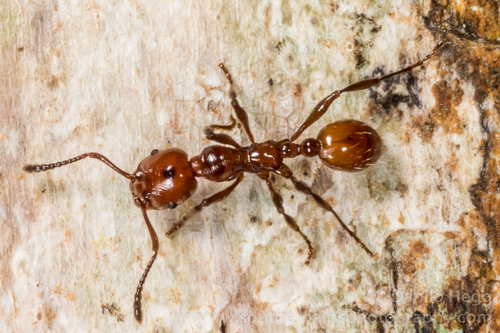
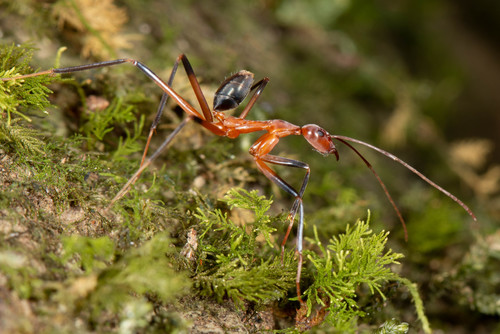
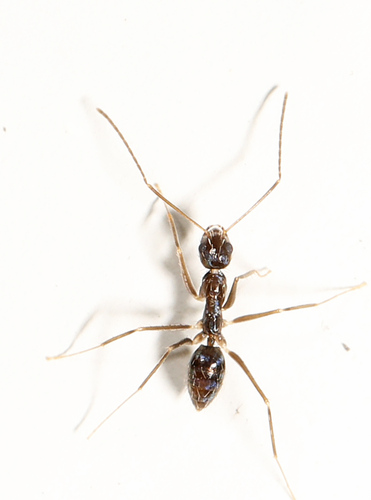
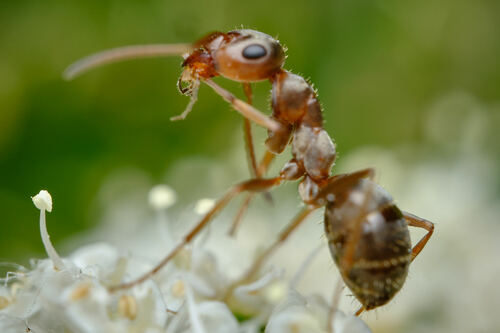
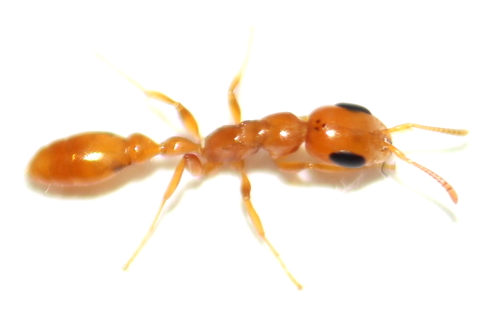
Morphology: Worker individuals of Pseudomyrmex pallidus are yellow, orange, or brown in color. They have a slender body shape, large eyes, short antennal scapes, and a well-developed sting. Head width of workers ranges from 0.68 to 0.89 millimeters. The head surface is shiny because it lacks a fine layer of hair. All worker P. pallidus are monomorphic, meaning they are uniform in size and shape. Both virgin female and male reproductive individuals of this species have wings. Mated queens that live in the nest can be identified by scars on their thorax where their wings were once attached, as well as by their distended gasters. Males are dark brown, have curved antennae and small heads.
Habitat: Nests of this species are built inside the hollow stems of dead grasses. While P. pallidus prefers to nest in herbaceous plants, nests have also been discovered in the dead stems of woody twigs. Nests are most commonly located where grassy and wooded habitats meet. This positioning likely provides shading from the tree canopy during warmer months, and exposure to sunlight during colder months. The colony entrance is a round to oblong opening 1 to 2 mm (0.04 to 0.08 in) wide on the surface of the stem. A single worker can easily block this entrance with its body to keep predators from reaching the colony's brood. Stems that host P. pallidus nests are 5 to 10 mm (0.20 to 0.39 in) in diameter, and the excavated nesting chambers inside range from 11.8 to 72 cm (4.6 to 28.3 in) in length.