About Pseudogynoxys chenopodioides (Kunth) Cabrera
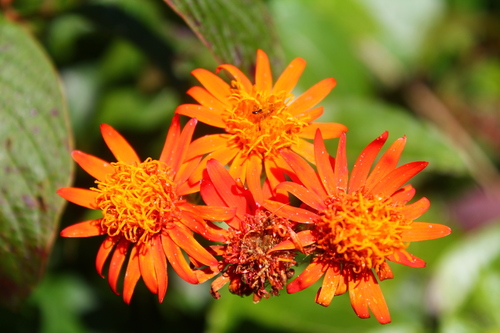
Pseudogynoxys chenopodioides (Kunth) Cabrera, commonly called Mexican flamevine, is a fast-growing twining herbaceous vine that reaches 5 to 10 metres (16 to 33 ft) in height. It has smooth, subcylindrical stems that are glabrous or puberulous, and develop slight woodiness as they age. Its evergreen leaves are simple, dull, alternate, arrowhead-shaped, toothed or serrated, 2 to 4 inches long, glabrous, somewhat fleshy, and shaped ovate to lanceolate. Leaves are often unequal and membranaceous with prominent venation, with a slightly cordiform, obtuse base and an acute apex; leaf petioles measure 1.5 to 2.2 cm long. This species is native from Veracruz, Mexico, south to Honduras in Central America, extending further south into tropical South America where it occurs in Venezuela, Colombia, Guyana and Suriname, and as far north as Southern California in the southwestern United States. It has become naturalized in Oahu (Hawaii), Puerto Rico, other parts of the Caribbean, possibly the Canary Islands, Texas, the United States Gulf Coast, India, Singapore, and multiple Pacific islands, and is an adventive species in Florida. It typically grows in moist habitats, but can tolerate mildly dry climates and moderate drought, and can survive at elevations over 2200 m. Mexican flamevine is grown as an ornamental plant prized for its showy flowers, which are pollinated by butterflies, hummingbirds and bees. It is widely cultivated as a climber or groundcover in gardens across parts of the United States, suited to hardiness zones 10 through 11, and can tolerate winter temperatures as low as -6.7 °C (20 °F) in zone 9a. It requires full sun, well-drained soil, and a trellis or shrub to climb on. Its fast growth allows it to reach maturity within the first year, making it ideal for covering unsightly fences. Regular heading back encourages foliage growth and blooming along the bottom of fences and trellises; if left unpruned, foliage and flowers will mostly accumulate at the top of the plant. Occasional removal of spent flowerheads boosts blooming across the entire plant. In colder regions, frost kills the plant’s aboveground shoots, but the roots can survive winter in most of the contiguous United States. Thanks to its rapid growth rate, it can be grown as an annual in cold climates. When not grown as a climbing vine, it takes on a sprawling, shrub-like form. It is moderately drought-tolerant, and grows well in a range of soil types including usually wet, somewhat alkaline clay, sand, acidic soil, and loam. The plant is mildly toxic if ingested. Handling it commonly causes dermatitis and an itching rash, and it is toxic to dogs, cats and horses. It has been cultivated in Hawaii since the early 1940s, with one recorded naturalization event during this time. It has been cultivated in Florida since 1939, where it has low to moderate commercial availability, has been reported to persist after cultivation, and grows on disturbed sites. It is sometimes sold commercially under the cultivar name 'São Paulo'.