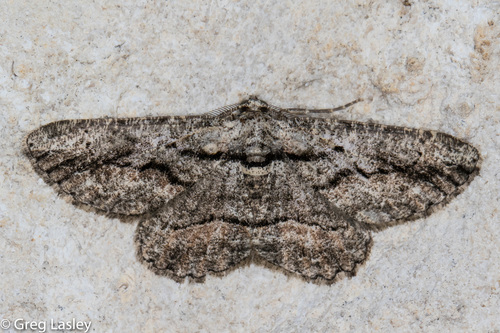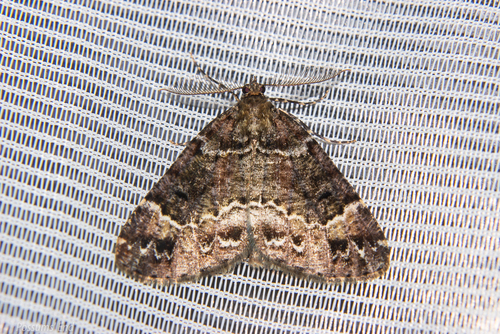
About Pseudocoremia productata (Walker, 1862)
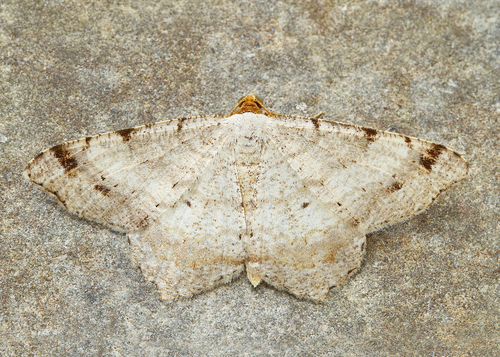
Adult Pseudocoremia productata, commonly called the Brown Forest Flash, are sexually dimorphic, and can be identified by characteristics of their wings, antennae, and external genitalia. The common name refers to two traits: the flashing of the moth’s pale hindwings during flight, and its ability to conceal itself on forest tree trunks. This concealment trait is called Protective Resemblance, a term that describes colors or body forms that let a species closely match its surroundings to avoid being detected by natural enemies. Females have pectinate antennae, which are comb-like filiform structures, while males have bipectinate antennae, with comb-like structures on both sides of the main antenna shaft. The moth’s head has short palpi that assist with taste and touch, which project a short distance in front of the eyes. The posterior margins of the abdominal segments have lateral tufts. In females, the tip of the ovipositor extends beyond the distal end of the abdomen. Males can reach a maximum wingspan of 1 3⁄8 inches (35 mm), while females can reach a maximum wingspan of 1 1⁄8 inches (29 mm). The forewings have distinctive wavy patterns, and their coloration varies from pale yellowish-brown to rich chocolate brown. When at rest, the hindwings are tucked under the forewings, making the moth undetectable thanks to its matching patterns and coloration. The moth’s predominant base color is dark reddish-brown, mottled with patches of creamy white and pale green, with scattered isolated hairs. The forewing pattern has two curved lines near the base, with a lighter stripe enclosed between these lines. A wide, dark central area is followed by a wavy pale line, which forms a light irregular band made of two partially disconnected patches: one on the leading front edge of the wing, and one on the trailing edge. A jagged, whitish transverse line is located near the termen, and curves toward the dorsum. The forewing pattern typically includes several dark streaks that stand out against the base color; some females may have cloudy white patches on their forewings. Hindwings are ochreous, with mottled greyish brown markings. Pseudocoremia productata is endemic to New Zealand, and is distributed across both the North and South islands, as well as Stewart Island. Adult moths are active from October through May, and are most abundant during the summer, though they can be recorded year-round. Collectors have observed that this species is attracted to light in mature habitats. It is widespread across New Zealand and has been recorded in many locations. Codfish Island, Waimakariri Basin, Lake Ferry, Humenga Point, Cape Palliser, Te Kaukau, Ahuriri Scenic Reserve, Onawe Peninsula, Hinewai Reserve, Macgregor Creek, and Robinson Slip are all confirmed locations for the species. This common moth is found in shrublands and forests. It may be observed resting on tree trunks, particularly on its host plant, White Rata. It is attracted to late summer blossoms, and can be found on the outskirts of densely wooded country or on the tree foliage of its host plant. Females lay pale green eggs on White Rata in irregular bundles that adhere to the surface where they are deposited. After a few days, the eggs turn bright reddish-brown. Eggs have an oval-globose shape, covered in multiple rows of hexagonal facets, and reach up to 1⁄4 inch (6.4 mm) in length. When fully grown, newly hatched larvae reach up to 1 1⁄2 inches (38 mm) long. Fully grown larvae are primarily ochreous, with sub-dorsal lines and numerous black bristles on the posterior segments. They have dark reddish-brown coloration marked with white and green mottles and stripes. During the day, larvae hold a stiff, motionless pose to mimic fragments of Rata tree, blending seamlessly with surrounding twigs. The larvae are nocturnal, only active at night, and feed on the foliage of various trees, making the species polyphagous. When ready to pupate, larvae dig small chambers two inches under the soil beneath their food plant, and enclose themselves in a small cocoon. According to Hudson (1928), the species has three generations per year: one in spring, one in summer, and one in autumn. Larvae that reach the pupal stage in late autumn remain in their cocoon over winter. In contrast, the pupal stage for spring and summer broods is much shorter, lasting only a few weeks.