About Pseudocolopteryx sclateri (Oustalet, 1892)
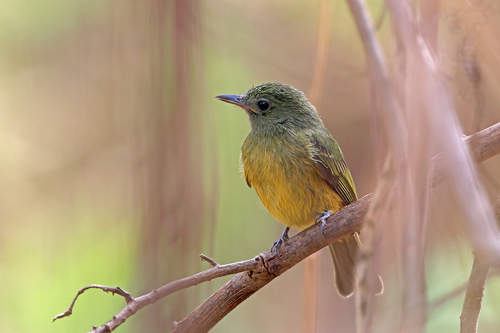
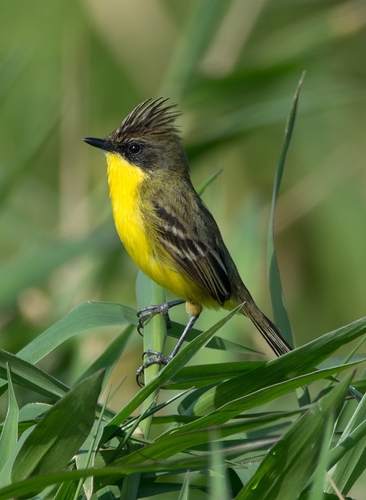
Description: The crested doradito (Pseudocolopteryx sclateri) measures 10 to 11 cm (3.9 to 4.3 in) in length and weighs 6 to 9.9 g (0.21 to 0.35 oz). Both sexes have a shaggy crest. Adult males have mostly pale olive head, upperparts, and tail. Their crown is blackish with yellowish white feather edges and a partially hidden yellow stripe down the middle. Their cheeks are dusky, and their back shows subtle dusky streaks. Their wings are pale olive, with dull whitish edges on flight feathers and wing coverts; the wing covert edges form two distinct wing bars. Their throat and underparts are bright yellow. Adult females have a paler head than males, wider pale-yellow edges on crown feathers, and a very faint pale yellow supercilium. Their underparts are paler yellow than those of adult males. Both sexes have a dark brown iris, and black legs and feet with a long hallux. Males have a slender, black, warbler-like bill; females have a black maxilla matching males, and a pinkish-orange mandible. Juveniles resemble adult females, but their crest has less black and more ochre, and their underparts are very pale. Distribution and habitat: The crested doradito has a highly disjunct distribution. Its largest continuous range extends from eastern Bolivia south through southwestern Brazil and Paraguay into northeastern Argentina and Uruguay. Isolated populations exist in other areas of Bolivia, Venezuela (mostly in Falcón), Guyana, and multiple regions of Brazil. It has been recorded as a vagrant on Trinidad. The South American Classification Committee of the American Ornithological Society holds unconfirmed sight records from French Guiana, and therefore lists this species as hypothetical there. The species lives in reed beds, marshes, and tall grassy areas near water. It occurs at elevations up to 500 m (1,600 ft) above sea level, but only reaches 200 m (700 ft) in Venezuela.